


Welcome to the positive corner of the internet. We’re here to make your life healthier, happier, and less stressful. At the bottom of each email, we explain our editorial process, stance on AI, and partnership standards.
If you were forwarded this message, you can get the free daily email here.
Today’s Health Upgrade
The simple science of increasing a child’s IQ
Should you be checking your blood pressure while you sleep?
5 ways to fill your fiber gap (without supplements)
Adam’s Corner: The story Arnold never told before
Family
The Free Brain Boost Parents Are Overlooking
There's no shortage of advice for parents who want to support their kids' development. Tutoring programs, enrichment apps, language classes, curated reading lists. The assumption underneath all of it is that cognitive growth requires the right input. Something to buy, enroll in, or add to an already crowded schedule.
Research suggests one of the most reliable things you can do for a child's brain is also the most accessible: get them moving.
A meta-analysis of 14 randomized controlled trials found that structured exercise improved children's general intelligence and IQ compared with children who didn't participate in exercise programs.
Researchers analyzed studies involving children ages 5 to 14. Because these were randomized controlled trials — not observational studies that track active kids versus sedentary ones — they could test whether exercise actually caused cognitive changes, not just whether the two happen to travel together. The answer was yes.
Beyond general intelligence, fluid reasoning and problem-solving both improved significantly. The gains held regardless of where a child started: both typical IQ ranges and borderline ranges showed meaningful improvement.
No single sport or activity format drove the results; benefits emerged across different exercise types, durations, and program structures.
Overall, active kids experienced a 4-point gain in IQ, which matters more than it might sound. Scores in that range can affect how quickly a child processes new information, adapts to unfamiliar problems, and manages the cognitive load of school. And these effects appeared during the years when the brain is most responsive to change.
Why does this happen? Physical activity increases blood flow to brain regions critical for learning, stimulates growth factors that support neural development, and strengthens the connections that help kids reason and problem-solve more effectively.
If you’re a parent wanting to support your child, know that consistent activity of any type is far more important than program design. Sports, bike rides, playground time, martial arts — the research doesn't point to a single winner. Which means there isn't a wrong answer. The only thing that doesn't work is skipping movement altogether.
Health
What Your Blood Pressure Does While You Sleep (And Why It Might Signal A Health Risk)
When you fall asleep tonight, your blood pressure is supposed to follow you down. That's not a metaphor. It's a measurable pattern, and new research on nearly 60,000 people suggests what happens when it doesn't.
A decade-long study found that people whose blood pressure failed to dip during sleep faced significantly higher risks of early death.
Researchers analyzed data over 10 years. They classified participants into four groups based on overnight blood pressure behavior: normal dippers (a 10–20% nighttime drop), reduced dippers (less than 10%), risers (BP climbs overnight), and extreme dippers (drops greater than 20%). After adjusting for overall blood pressure levels, both reduced dippers and risers showed elevated mortality risk.
Risers (whose blood pressure climbed overnight rather than fell) faced roughly 41% higher all-cause mortality compared to normal dippers.
Here's what makes this worth paying attention to: the researchers controlled for overall blood pressure. That means even participants whose nightly numbers looked fine faced an elevated risk when their circadian pattern was off.
Researchers believe the overnight decline in blood pressure is part of a recovery window — a period when cardiovascular stress is reduced. When that window shrinks or disappears, the heart and blood vessels get less rest. Sleep disorders like apnea, chronic stress, high sodium, and evening alcohol are all connected to blunted dipping patterns in separate research.
This is observational work, so we can't draw a straight line from dipping to mortality. But the association across nearly 60,000 patients over a decade is consistent and hard to dismiss.
If you want to improve your evening blood pressure, prioritize better sleep hygiene (such as going to bed and waking up at the same time), less evening alcohol, lower sodium, and regular exercise. The habits that support your body's overnight rhythms tend to be the same ones that protect everything else.
Reader Question
Houston, We Have A Fiber Issue.
I took the fiber quiz last week and yikes! You didn’t prepare us for the shock and guilt. My fiber gap was 25 grams. I’ve made some changes, and I got Fiber+ (the cinnamon is A+. Thanks for the bonus recipes). Feeling good, but I’m still more than 10 grams short. Any ideas that aren’t complicated or expensive? -Tim, Austin
Tim, first, put down the guilt. A 25-gram fiber gap puts you in the majority. As we’ve shared, 95% of people don’t get enough fiber — and most don’t even realize that the average person gets only 50% of the recommended amount. That’s why we shared the fiber quiz, so you could be more aware and take action.
Ultra-processed foods dominate grocery store shelves. Fiber gets stripped out of almost everything during manufacturing. You're not behind. You just finally understood where you were at and what you needed to do to change.
Now let's close the fiber gap.
You've made some changes, and you're 10 grams short. That's not a mountain; that's two or three easy swaps. Here's where to look:
Beans are the cheat code. Half a cup of black beans, chickpeas, or lentils adds 7-8 grams of fiber in one shot. Throw them into whatever you're already eating: a salad, a wrap, a bowl, a soup. They cost almost nothing, and they don't change the flavor of a meal much. If you do nothing else on this list, do this one.
Add chia seeds to something you already eat. One tablespoon in a smoothie, yogurt, or oatmeal adds 4 grams. They're flavorless. You will not notice them. Your gut bacteria will.
Eat the apple with the skin on. You're getting 4-5 grams. Affordable, portable. And goes well with almost any meal.
Go berry nuts. Grab one handful of almonds along with a half cup of raspberries, and you’ll get nearly 8 grams of fiber.
Grab the popcorn. Not typically seen as a health food, 3 cups of popcorn have about 3.5 grams of popcorn (just don’t go heavy on the butter).
Pick two or three of these swaps, and you're there. That's it.
Adam’s Corner
All The Small Things
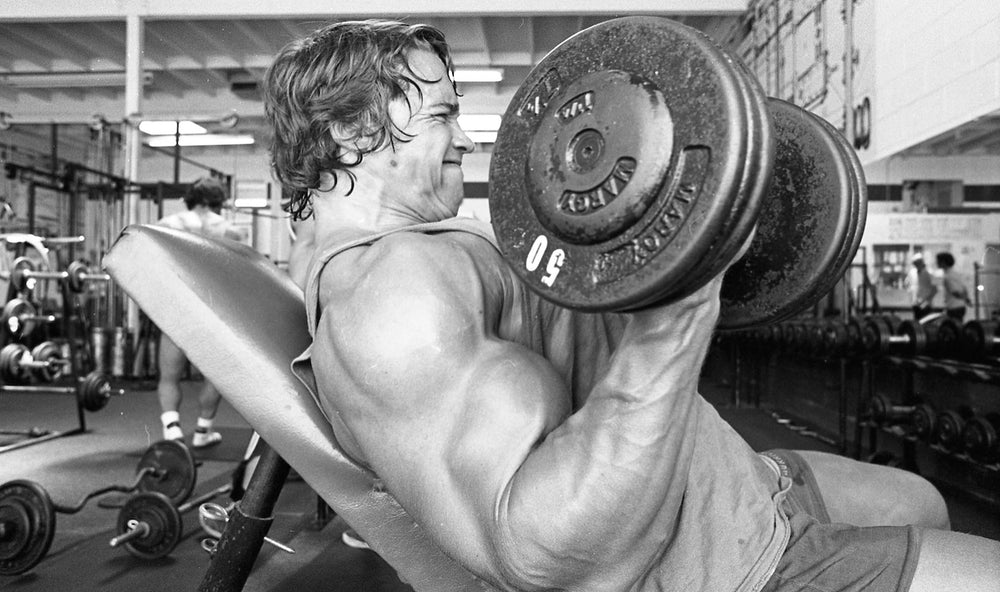
The Pump Club Lounge at the Arnold Sports Festival is the ultimate community experience hidden within an event unlike anything you’ve seen.
The main event is the expo floor: more than 100,000 people, every kind of athlete, the whole spectrum of human effort and competition. The lounge has the same energy, but it’s a place built around conversations and connection.
And one conversation in particular made me rethink the idea of power and influence.
This year, when Arnold stopped by the Lounge, he told a story I hadn’t heard before.
The first part, many people know. In 1972, Arnold was posing in South Africa when a platform collapsed beneath him. Torn ACL. Kneecap displaced. Surgery followed, and the injury was considered potentially career-ending.
Then, because Arnold is Arnold, he came back and won Mr. Olympia in 1973, 1974, and again in 1975, with legs that were improbably better than before.
That’s the part that gets told. I’ve heard it many times before. But this time, there was a wrinkle that I’ve never heard Arnold share in the 14 years I’ve known him.
Months into his recovery, things were not progressing well, and his doctor asked how training was going. Arnold said he was squatting 135 pounds.
The doctor then asked: How much were you lifting before the surgery?
Four hundred pounds. For reps.
The doctor looked at him. Why aren’t you lifting more? Your knee is healed.
That was it. Not a speech. Not a program redesign. A question. The doctor looked at the gap between what Arnold was doing and what he was capable of, and he simply asked: why?
In a few months, Arnold built his way back to 400-pound squats. Then won Mr. Olympia.
I sat in the lounge thinking about the doctor. And the subtle power he had to change bodybuilding history and so much more.
The Things We Hold Inside
Not too long ago, I met a woman in the Pump Club app named Peggy. I don’t remember all the context, only the moment: I watched her deadlift at a Pump Club deadlift-and-ruck event and said what I observed. I told her she was strong. Not as encouragement. Not as flattery. Just as a fact, the way you’d remark on something obvious.
Later, Peggy shared what happened next. It changed what she thought of herself. She went from doing bodyweight exercises to powerlifting. She joined a lifting club in her late 50s. Did her Pump Club workouts. And then became a champion.
Then there was Jeff — Hoop as we know him in the app — a guy I’d told the same thing. In last year’s lounge, he nearly pulled 600 pounds. I told him what I saw and how strong he was. That changed encouraged him, and this year he competed at The Arnold Sports Festival in The World’s Strongest Firefighter.
I’m not claiming credit for either of them. They did the work. They showed up. To me, I had no impact. And yet, to them, I did more than I realized. Because somewhere between what I said and who they became, a door opened.
When I wrote about my father — his diagnosis, the three years he fought brain cancer, the way he chose to live instead of waiting to die, the pain of his loss, and the grief I continue to sort out — I nearly didn’t publish it. It felt too personal. Too raw.
I shared it anyway.
Hundreds of people reached out. And then this past weekend, multiple people came up to me personally to tell me I changed their lives.
People told me about broken relationships with their parents that they fixed. Then there were those who said it changed how they talked to their children. Another one told me that reading “Portals” helped him get out of his darkest depression.
My father was gone. But something he gave me that I shared in these newsletters became something I could share with strangers he would never know or meet.
And then it hit me: What you say in an honest moment has a half-life longer than you will ever know.
That’s why I kept thinking about Arnold’s doctor.
The man didn’t change Arnold’s body. Arnold did that himself, in the gym, rep by rep. The doctor just asked a question. A genuine one. He looked at the evidence in front of him — a healed knee, a champion operating at a fraction of his capacity — and said: Why is this person still acting like they’re limited?
That question removed a limitation Arnold had built for himself.
We all find ourselves in moments of doubt, struggle, and hardship. Sometimes, the future doesn’t seem bright. And when that happens, the door to our potential suddenly seems locked.
And then someone says the right thing at the right moment, and the door opens.
We all have the potential to break down our own barriers. But we also possess the power to do the same for others, even strangers.
We walk around carrying positive observations about the people in our lives. Things we notice. And we keep them to ourselves because it feels presumptuous, or vulnerable, or because we’re not sure it’s wanted.
A positive thought sitting inside your mind is worth nothing. Said out loud, it might be worth everything.
Because of that, it’s worth considering: when was the last time you told someone something true, authentic, and genuine about what you saw in them, just because you noticed it?
Arnold says we have the strength to lift the world. It’s stitched on Pump Club t-shirts and serves as the deeper purpose behind all of these emails.
Ketchell and I are just two average humans compared to Arnold. We don’t have trophies or movies. We haven’t been governor. But we have the power to share information and tips in these newsletters, to pump people up daily in the Pump Club app, and to speak the truth when we meet them in person, and to coach and support them in a way that leaves them better than we found them. The same goes for Coach Jen and Coach Nic.
And when we do, despite being ordinary, we possess the same extraordinary power as Arnold. Once you see what a few words can do, you realize there is so much more impact you can make.
Each of you carries the ability to lift the people around you, if you’re willing to open your mouths and say what you actually see, or take action and support the people you interact with.
Arnold’s doctor asked a question and went home. I told people they were strong and thought nothing about it.
That’s the thing about small things. You won’t always know whether you’ve done anything.
But if you feel it, say it anyway. You never know when the words that “didn’t matter” are the little nudge that changes everything. -AB
Better Today
Take any of these tips from today’s email and put them into action:
1. Exercise Improves Children's Problem-Solving and IQ
A meta-analysis of 14 randomized controlled trials — not observational studies — found that structured exercise produced a 4-point IQ gain in children ages 5 to 14, with improvements in fluid reasoning and problem-solving that held regardless of whether a child started in a typical or borderline IQ range. Physical activity drives these gains by increasing blood flow to learning-critical brain regions, stimulating neural growth factors, and strengthening the connections that support reasoning under cognitive load. For parents, the research's most practical finding is also its most liberating: the specific sport or activity format didn't determine outcomes, which means any consistent movement — playground time, martial arts, bike rides, team sports — counts equally.
2. People Whose Blood Pressure Doesn't Drop During Sleep Face 41% Higher Mortality Risk
A 10-year study of nearly 60,000 people found that those whose blood pressure failed to drop during sleep faced significantly elevated mortality risk even when their absolute nighttime readings appeared normal. And those whose pressure actually climbed overnight, called "risers," showed 41% higher all-cause mortality compared to people with a healthy dipping pattern. Researchers believe the overnight pressure decline functions as a cardiovascular recovery window: when it disappears, the heart and blood vessels accumulate cumulative stress that standard readings don't capture. Improving sleep consistency, cutting evening alcohol, lowering sodium, and exercising regularly all support healthier overnight dipping patterns — and they're the same habits that protect cardiovascular health across every other metric.
3. The Average Person Gets Half the Recommended Daily Fiber. Here's How Five Cheap Swaps Fix That
With 95% of people falling short of daily fiber targets and the average person consuming only half the recommended amount, the problem isn't effort — it's not knowing where the grams are hiding. Half a cup of black beans or lentils adds 7–8 grams per serving; one tablespoon of chia seeds adds 4 grams with no detectable flavor change; a handful of almonds paired with half a cup of raspberries delivers nearly 8 grams in a single snack. The strategy isn't about replacing meals — it's about stacking fiber into the food you're already eating. If you need extra assistance, Fiber+ is an NSF Certified For Sport product that combines three sources of fiber to help your gut health, digestion, and cardiovascular health.
4. The Question Arnold's Surgeon Asked That Changed Bodybuilding History (And What It Means for Your Own Limits)
At the 2026 Arnold Sports Festival Pump Club Lounge, Arnold Schwarzenegger shared a detail from his 1972 ACL recovery that he's never made public before: months into a plateau, his doctor asked a single question — "why aren't you lifting more, your knee is healed?" — and Arnold returned to 400-pound squats and won back-to-back Mr. Olympia titles in 1973 and 1974. The story carries a principle Arnold's coaching philosophy has always implied but rarely stated directly: even elite competitors build invisible ceilings around themselves, and the most effective intervention is often someone who notices the gap between what a person is doing and what they're capable of. Adam Bornstein's account of how that same dynamic played out with real Pump Club members — a woman in her late 50s who became a powerlifting champion, a firefighter who competed at the Arnold — makes the case that the power to say something honest and specific about what you see in someone is one of the most underused, highest-leverage things any of us carry.
The Positive Corner of The Internet
About Arnold’s Pump Club Editorial Standards
We do things a bit differently here, starting with transparency.
The Content: All APC emails are researched, written, and fact-checked by the APC editors (see bottom of the email), with written contributions from Arnold (noted with “Arnold’s Corner”). Links take you to original studies (not second-hand sources).
Does AI play a role? Not for the primary content, but it is used in two ways. The main items are original content written by the APC team. The summaries at the end are AI-generated based on the human-written content above. We also use an AI tool to review our interpretations of the research and ensure scientific accuracy. We don’t assume AI is right, but we use technology to hold ourselves accountable.
Yes, we have partners (all clearly noted). Why? Because it allows us to keep the APC emails free. We first test products, and then reach out to potential partners who offer ways to help you improve every day. The bar is set high, and to date, we have turned down millions in ad deals. (Example: we will not partner with any non-certified supplements or those without evidence in human trials). If we won’t buy the product, we won’t recommend it to you. And if there’s no evidence it works, then there’s no place for it here.
—
Publisher: Arnold Schwarzenegger
Editors-in-chief: Adam Bornstein and Daniel Ketchell