


Your Most Comfortable Shoes Might Be Wrong For Lifting
There's no best shoe for every type of exercise. There's a best match between the shoe, the type of workout, and the results you want.
Together with NOBULL
The 3-Minute Test Your Training Shoes Should Pass
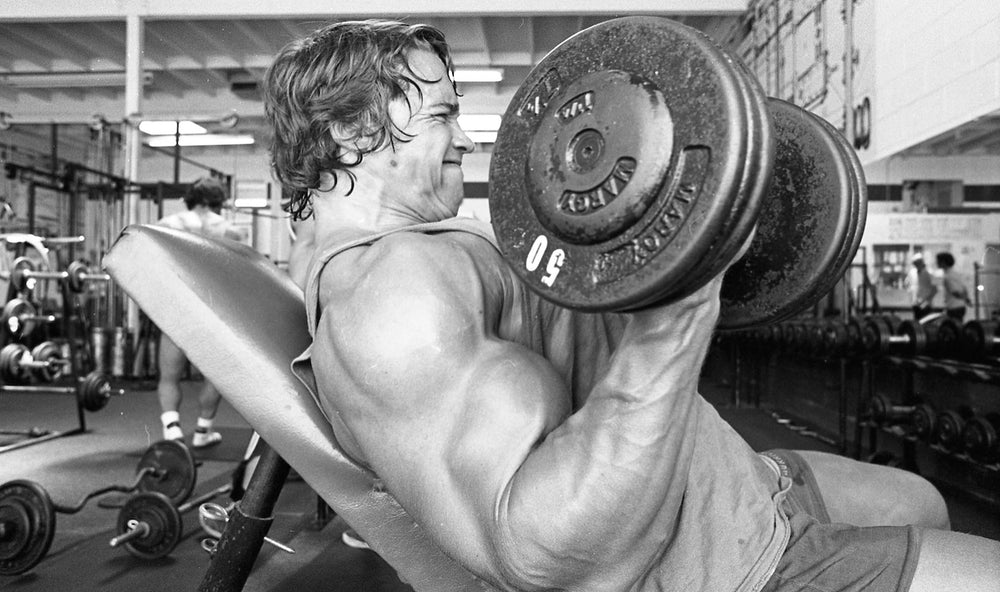
Look through old photos from the Pumping Iron years, and you'll see Arnold squatting barefoot. Shoes were barely part of the conversation. The work was the iron.
Arnold has since said they knew much less then. Some of the knee, back, and foot pain everyone accepted as part of serious training may have come from wearing the wrong shoes, or no shoes when a pair would have helped.
But like so many things, Arnold was ahead of his time. Unlike running, barefoot training has many benefits, especially if you’re wearing the wrong shoes.
When under a heavy barbell (or really when holding any weight and trying to generate force, the surface beneath your foot should hold still.
But a no-shoes approach also has some limitations (not to mention, some gyms don’t love it).
And your shoes — at least the right shoes — have a job that’s far more important than looking good.
A running shoe is built to soften thousands of landings.
A lifting shoe needs to give you a stable base to push against.
A shoe for court sports or mixed training needs grip when you move sideways.
There is no best shoe for every workout. But there is a best match between the shoe and the work you want to do.
Don’t Miss It
If you want a special offer on the shoe we recommend, Pump Club readers get $50 OFF this weekend only. To access your discount, use the code APC50.
Comfort Is The First Test (But Not The Last)
Comfort matters more than shoe marketing admits. And that’s probably because “comfort” is more subjective.
In 2015, researchers proposed the "comfort filter": runners may naturally favor shoes that allow them to stay closer to their preferred movement pattern, which could reduce injury risk. It was a proposed model, not proof that the shoe that feels best will prevent injury.
But it aligns with what you see anecdotally and in studies: how you feel influences how you perform.
And that’s part of the difficulty with finding the right shoe.
A walk across a store can tell you about pinching, rubbing, and obvious fit problems. It can't tell you what happens when a barbell and your body weight press into the sole, or when you plant hard and change direction.
That is where the material under your foot matters.
Soft foam compresses. During a run, that can make repeated landings more comfortable.
During a heavy squat or deadlift, the same foam can make your heel sink or shift while you try to produce force.
One study had lifters squat at 60 percent of their one-rep max in running shoes and again in weightlifting shoes with a firm, raised heel.
The weightlifting shoes reduced forward torso lean, although squat depth and thigh angle at the bottom did not differ. The shoes changed the position. They did not transform the lift. But those little things shift how you feel and move, and they influence the comfort and confidence you bring to training.
Research on unstable-surface training helps explain the tradeoff.
A cushioned shoe is not the same as standing on a balance device, so we shouldn't pretend that research proves soft shoes are dangerous.
It does reinforce a basic point: if the goal is to produce a lot of force, stability (especially in your feet) helps.
Wearing running shoes for a few sets of squats doesn't guarantee an injury. The more likely cost is smaller and immediate: less stability, less predictable footing, and more effort spent controlling the base.
As you get stronger and the weights increase, this becomes a bad trade.
Match Your Shoe To Your Workout
If you want to ensure stability, comfort, and performance, start with what you do most often.
All shoes cover your feet, but not all shoes cover what you need to move efficiently, safely, and powerfully.
Here’s how your footwear influences your preferred form of exercise:
Heavy deadlifts and general strength work
Look for a firm, low sole with little compression. Staying close to the floor gives you a base that doesn't wobble under load. Socks or a flat, thin-soled sneaker can also work if your gym permits it, though a training shoe adds grip and protection. Some deadlift platforms are slippery, so the right shoes become a necessity.
Deep squats and Olympic lifts
Some people do better with a firm, raised heel, especially if limited ankle mobility makes it hard to reach depth without the heels lifting. The raised heel lets the knees travel farther forward and can help the torso stay upright. That same heel adds distance to a deadlift, so it isn't automatically better for every lift.
Running and walking
Cushioning and a flexible forefoot make sense when the job involves repeated steps (and mostly moving forward). Comfort deserves more weight here than it does under a heavy bar. A running shoe that feels good and lets you move naturally may be an excellent running shoe even if it is a poor lifting shoe.
Mixed training, agility, and conditioning
Look at the outsole and the foam. Running tread is designed mostly for forward travel. Shuffles, cuts, and quick stops require grip in several directions, plus an upper that keeps the foot from sliding inside the shoe. A low-to-moderate stack height can provide some impact protection without making lateral movement feel loose.
A shoe that has enough “give” for long runs gives up some stability under a heavy bar. A dense, low lifting shoe will feel harsh over miles of pavement. If you lift and run regularly, two appropriate pairs can be more useful than one expensive pair forced into both jobs.
Or you can find a hybrid shoe designed to help you lift and move.
And while small details can matter, sometimes they're overstated. Take your arch, for example. Scientists followed nearly 1,000 runners for a year, all wearing the same neutral shoe.
Runners with moderately pronated feet were not injured more often than those with neutral feet. The study was observational and included too few highly pronated runners to draw conclusions about them. But the point was that matching a shoe to the activity and then assessing your comfort might be more useful than trying to "correct" a foot that rolls inward.
Test Your Shoes In Minutes
We know that finding the right shoe can seem like a guess. So here’s a quick assessment you can use in a store, at home with a new pair, or on the shoes in your gym bag. And make sure you test both feet.
1. Check the fit while standing
Your longest toe should have about a thumb's width of space in front of it. The heel should stay in place when you walk, and the upper shouldn't pinch. Try to spread your toes. They need room to widen under load rather than being pressed together by the toe box.
A study comparing people who had spent their lives barefoot with habitual shoe wearers found wider feet and more evenly distributed pressure in the barefoot group. People who wore looser shoes fell between the barefoot group and those with slim feet who wore shoes. The comparison can't show that shoes caused those differences.
It does support a practical check: the toe box should leave enough room for the forefoot to spread.
Shoe size varies by brand, and feet can change over time. If it's been years since you last measured your feet, measure both while standing, preferably later in the day when they're at their largest.
2. Inspect what is under your foot
Press your thumb hard into the midsole beneath the heel.
Deep give tells you the shoe was built to absorb force. That may be useful for running and walking; it is usually a poor match for heavy lifting.
Then hold the heel and toe.
The shoe should bend where your forefoot bends, not fold through the middle. Give it a gentle twist. A lifting or cross-training shoe should resist enough that it doesn't feel flimsy, while a walking or running shoe still needs enough flexibility to move with your stride.
Turn it over. Forward-facing tread suits straight-line movement. A pattern that grips across several angles is better suited to lateral work and quick direction changes.
3. Make the shoe do the job
Remember how we said the activity you do matters? Try to simulate it as much as possible.
Walking shoes? Walk for 30 seconds. More of a runner? Jog in place if the shoe is for running or conditioning. Do 10 small jumps and notice whether your foot slides inside the upper. Balance on each leg for 20 seconds. If the shoe is for lifting, do your best bodyweight squats.
Watch for heel movement, toe pressure, sinking, or a feeling that you have to fight the shoe to stay balanced. Whatever shifts during a bodyweight squat is unlikely to improve when you put a bar on your back.
(That’s why we appreciate NOBULL and their trial-and-return policy).
Test Your Foot, Too
A shoe can provide a better platform. It can't make a weak or poorly controlled foot strong.
Take the shoes off and repeat the single-leg balance test.
Stand barefoot on one leg with your hands on your hips and try to hold the position for 30 seconds without touching down or moving your arms. A lot of wobbling doesn’t diagnose a problem, but it can expose a weak link in foot strength, ankle mobility, or balance.
A shoe will help you feel steadier, but it can’t replace the ability to control your foot and ankle.
Then try to spread your toes without curling them into the floor. Trouble with either test doesn't diagnose a problem, but it gives you something useful to work on.
In a randomized trial, runners completed either eight weeks of foot-and-ankle strengthening three times per week or five minutes of stretching on the same schedule, then continued on their own.
After a year, 14 percent of the strengthening group and nearly 33 percent of the stretching group had reported a running injury. It was one trial, and the injuries were self-reported, so treat the exact percentages cautiously.
But the results suggest the shoe is an important piece of equipment for training your feet.
A few minutes of arch raises, toe spreading, and single-leg balance can help. If you switch to a shoe with much less cushioning or a very different heel-to-toe drop, introduce it gradually.
A new shoe changes the demand on the foot, ankle, calf, and Achilles. Give those tissues time to catch up.
Why We Train In The Outwork
You can run every test in this email on any shoe at any price. And it will help you find the right shoe for your feet and your preference.
We spent 2 years trying, testing, and training in different pairs of shoes. We put them through all the exercises and movements we do, and the winner was the NOBULL Outwork.
The NOBULL Outwork is built for strength training and designed to science-backed specifications.
Its 4-millimeter heel-to-toe drop and low stack keep the foot close to the ground. The stability-tuned midsole limits the soft, sinking feeling you get from a running shoe, while the circular rubber tread grips the gym floor. The toe box gives the forefoot room to spread under load.
If your training revolves around heavy barbell work, the original Outwork is the most stable platform we've tested.
If your week is strength, conditioning, and classes, the Outwork Flex gives you the same grounded feel, but it breaks in easier.
One is a specialist. The other is the shoe you'll actually live in.
This weekend only, Pump Club readers get $50 off every Outwork shoe. Not one model. The whole franchise, including the OG and the new Outwork Flex.
Use code APC50 at checkout, and click here to shop the Outwork collection.
The deal ends Monday. After that, it's the same great shoe for $50 more.
—
Publisher: Arnold Schwarzenegger
Editors-in-chief: Adam Bornstein and Daniel Ketchell