


The Training Mistakes That Prevent You From Reaching Your True Potential
Most of what people believe about getting fit is the opposite of what works. Here are 5 changes (and the supporting science) that can upgrade your results at any age.
Welcome to the positive corner of the internet. We’re here to make your life healthier, happier, and less stressful. At the bottom of each email, we explain our editorial process, stance on AI, and partnership standards.
Pump Club: Open House Week
All week, we’ve been giving you insider access to the Pump Club App coaching calls. That continues today with two opportunities.
Train With Ketch: 5:00 AM Pacific/8:00 AM Eastern
Join Co-CEO Daniel Ketchell for the final workout of the week. Show up to learn more about the “Short On Time” Foundation program or ask questions about training. Join the workout here.
Form Checks With Coach Nic: 6:00 AM Pacific/ 9:00 AM Eastern
Join the “Film Room” with World’s Strongest Man (under 90 kg) and coach extraordinaire Nic Myers, as he walks through all the form questions for the week and teaches how to get the most out of every exercise.
If you’re new to this: you can submit a video, Nic will review it, and break down how to improve. Join the call here.
“You Look Like A Different Person”
Editor’s note: At 28, I did everything the fitness industry tells you to do.
At 42, I eat ice cream with my kids, train three times a week, and look and feel undeniably better.
But this isn’t your typical “look at me” post. It’s an honest reflection of what I did wrong for so long, what I’m doing right now, and how people of every age are seeing dramatic changes they didn’t think were possible. And it’s why we’re willing to bet the entire cost of the app on you seeing it, too. -Ketch
—
When our amazing teammate Robby recently shared the GTA meme on social media (see below), a few friends texted me the same thing:
“It’s like you’re a different person.”
(It also made me feel old. Like most memes.)

If we haven’t met, I’m Ketch. I’ve worked with Arnold for 20 years, and today I run the Pump Club with Adam and Arnold. I focus on the Pump Club app, and because we believe in leading from the front, I use the same programs and nutrition plans as every member.
My friends know I’ve trained for years. A lot of us have done workout challenges together going back to our days in the Governor’s office.
When I look at that first photo from 14 years ago, I see more than a baby face. I see someone who trains. There’s a hint of abs and some muscle on the arms.
But the difference between 28-year-old Ketch and 42-year-old Ketch is pretty damn extreme.
And that got me thinking. I trained for more than a decade. I was fit. But year after year, my progress was marginal at best.
So how, in my 40s, on fewer days in the gym, am I making better progress than ever?
I came up with five things (which I share below in detail). None of them is a secret supplement, more days in the gym, or a magic diet.
Most of them are the opposite of what I used to believe.
You’ll see why my arms got bigger when I stopped chasing arm days.
Why three days a week beat all the extra days I used to grind out.
And a simple test that shows how much effort you’ve been leaving in the gym on every set, why the half rep you think is saving your knees may be the thing holding you back, and why the fasting I swore by might have been costing me muscle.
But first, I want to show you what I used to do, and why not all transformations are created equal.
Because this works whether you’re like me (42, dad of three), like Sandra (who started at 59), or like Filip (who got shredded on bodyweight alone, without a gym).
Looking Back: What 28-year-old Me Did
I trained more often, with workouts I bought online or found in a magazine.
I trained arms and abs more, and big compound lifts less.
I chased “intensity,” which meant being soaked in sweat. (Anybody remember “the Spartacus workout”?)
I avoided carbs. I fasted every day until lunch, and often once a week I’d fast all day and eat one meal.
Basically, I did everything the fitness industry sells.
To be clear, I was in good shape. A lot of people who started where I did, with a little beer belly and not much muscle, would be right to be happy there.
But every day I answer questions from people who don’t believe they can get results training three or four days a week.
From people who think they need more direct arm or ab work. From people who say our programs aren’t intense enough. From people who think they can’t eat anything but meat.
The gap between those photos answers all of them.
And no, the answer isn’t just Pump Club. But it’s a big part of it.
The Fair (And More Dramatic) Comparisons
Let’s be honest about something: 14 years is a big gap. So, for complete fairness, here’s a much shorter transformation. On the left is me the month we launched the Pump Club app, and on the right is 3.5 years later.

My weight is about the same in both. That’s why I track with the mirror, not just the scale.
The lighting is better in the recent one. But lighting doesn’t build a chest.
And here’s the hopeful part. The change in these two photos, 3.5 years apart, is MUCH bigger than the change from 2012 to 2023.
I made more progress in the last three and a half years than in the decade prior.
I know some people will read this and say, “Well, you’re a dude, and I’m a woman.” Or, “You’re 42, and I’m 60. This doesn’t apply to me.”
Allow me to introduce you to Sandra.
Meet Sandra
“I had just turned 59 when I joined the Pump Club in March 2023. I felt very comfortable in my body for a long time. I ate OK. I worked out. Walked. I did a lot of the right things. Health numbers solid. Every year, I got the ‘keep doing what you’re doing’ from my doctor. … After joining APC, something clicked and brought out something I’d never experienced. … A 20-pound drop happened over three years. Slow and steady. But that wasn’t the goal in March 2023. Getting stronger and yes, trying my best to slow the clock a bit were my goals. … APC is for everybody. And Every Body.” -Sandra

She was already doing “a lot of the right things.” So was I. Different gender, 20 years older, same story.
I know some other people will say, “I don’t want to be like you and train with heavy weights, so this still isn’t for me.”
Neither did Filip.
Meet Filip
Filip used the Pump Club app and stuck entirely to our bodyweight programs, proving you can get ripped without equipment.
He played basketball and tennis for decades, ate “pretty much garbage,” and enjoyed his beers.
At 46, here’s where he landed without a gym.

“That stubborn belly fat is finally gone. I went from zero to 15 pull-ups and 37 push-ups. At 46, I have a lean, athletic physique and feel stronger and more disciplined than ever.” -Filip
5 Lessons That Will Accelerate Your Results
So how did this happen? Here are the five things that changed everything for me, including the science behind each.
You can use each one immediately, with or without our app.
1. Invest In Strength
For years, my only goal was to look decent and be someone who trains.
That changed in 2019, when I was about to turn 35. As a sports fan, I knew we talk about athletes at 35 like they’re past their prime.
The goal was a 400-pound trap bar deadlift. I’d never touched more than 315.
I told Adam I needed help. Naturally, it was 8 weeks before my birthday. He wrote a plan, and I hit 400 on my birthday with Arnold and some friends.
I was hooked. The next year, the birthday goal was 500. Then it was the thousand-pound club (squat, bench and deadlift total).

2020: My first 500. The ugliest.

2021: 500 again. Still ugly.
Chasing strength became my reason to train. And strength can build size.
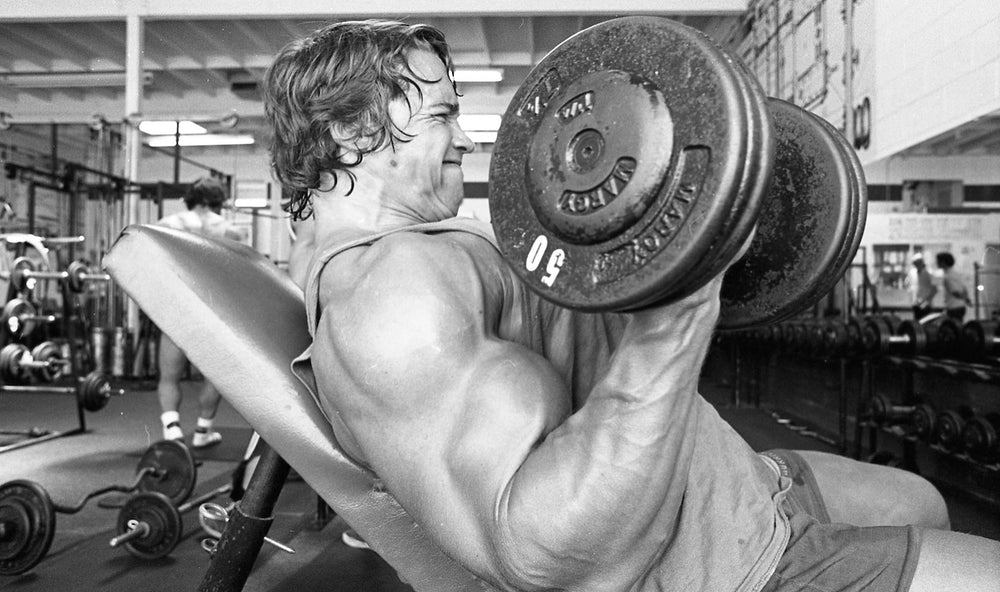
Arnold shocked the bodybuilding world at 18 because of how big he was. He credits the base he built in weightlifting and powerlifting. From 15 to 18, he wasn’t allowed to do curls, or even chin-ups, until he’d done his big compound lifts at the weightlifting club. If that sounds familiar, it should. It’s literally the Foundation.
As I trained harder for strength, my weight stayed around 160 to 165 pounds. But I looked bigger.
Here’s a video of the strength progression. In those early years of annual strength challenges (2019-2023), something was still missing.
The Science: When researchers analyzed 67 training studies, the model that best predicted muscle growth counted each set of a compound lift as about half a set for the muscles it helped.
A set of bench is roughly half a set of triceps work. A set of rows is roughly half a set for your biceps. (Pelland et al.) That helps explain why trained men who added curls and triceps extensions to their compound lifts saw no significant extra arm growth or strength over 8 weeks: their arms were already being trained. (de França et al.)
Putting it into practice: Do the math on your own week. Four hard sets of a press, three days a week, is 12 pressing sets.
That’s about six sets of triceps work before you’ve done a single pushdown. Rows and chin-ups do the same for your biceps.
So pick four big lifts: a squat, a hinge, a press and a pull. Do them first in every workout, while you’re fresh. Write down your best set on each one, and give yourself a number to chase with a date on it, like my birthday deadlift. Arm and ab work comes after, if you have time. It’s the top-off, not the engine. In the app, this is how the Foundation is already built: big lifts first, everything else after.
2. Consistency Compounds (Stick to the Program)
Every year, I reached out to Adam (the other Pump Club Co-CEO), gave him an overly ambitious goal in too short a time, and he would put together an 8-12 week plan to help me accomplish my vision by my birthday.
Each year, we achieved the goal. Then I went back to doing my own thing. I played. I leaned on my favorites. (I deadlifted a lot.)
I can’t lie. I knew programs worked. Those 2 to 3 months with Adam in charge were my best months, every year. I took the wheel back anyway.
The app flipped that switch. First I had to test the Foundation. Then, to lead the app team, I had to keep using it, just like our members. (Maybe other business leaders don’t feel that way, but they wouldn’t survive in Arnold-world.)
For the first time, I put someone else in charge full time, and I never once decided I knew better.
Trusting someone else with your programming is not just a beginner thing. Our movement coach in the app, Nic Myers, is an actual World’s Strongest Man, and he has coaches and does the exact same thing.
So I never had the dramatic three-month transformation so many members have after their Foundation program. I’d done plenty of three-month stretches. What I’d never done was a full year, then three.
Stacked up, those gains look almost exponential.
I can’t overstate how much being on a program matters. My friends who use the app all say it. Going from fitness classes or choose-your-own-adventure training to a program built around progression is an insane difference-maker.
Friends who thought they had to hit classes 6 days a week just to tread water with their fitness see results on 3 to 4 days a week that they can’t believe.
The fitness industry preaches more, more, more. More is always better.
Training with a program broke that mentality for me.
Right now, I train Monday, Wednesday, and Friday, and I’m making gains. In the last three years, the most I’ve trained in a week is four days.
I train smarter. And I train harder.

2025: 600. Not ugly.
The Science: Two large analyses, one of 25 studies and one of 67, found that when total weekly work is the same, training a muscle more days per week adds little to no extra muscle. (Schoenfeld et al.; Pelland et al.)
And a 2022 review found that planned changes to your exercises can help, but changing exercises randomly and too often may hurt your gains. (Kassiano et al.)
Putting it into practice: Stop counting days. Count hard sets, and see whether your numbers go up. If you do in three days the same work you used to spread over six, the research says you build about the same muscle, and you get three days of your life back.
Run one program for 12 weeks. Similar movements, every week. Write down the weight and reps for every set, then try to beat one number next time: one more rep, or a little more weight. When you hit the top of the rep range on every set, add weight.
Don’t swap in new exercises because you’re bored. You can swap within the same movement pattern (we take care of this in the app), but not for something entirely different, because exercise order matters. And boredom isn’t a reason to change. A stall is. In the app, every program is already built this way and logs every set for you. If life gets in the way, hit Not Today and you pick up right where you left off.
3. Embrace “First Set Mindset” (Intensity)
This was a slow-rolling lesson. Chasing deadlift goals taught me to push hard reps there. But I didn’t bring that to every lift right away.
I didn’t push squat and bench until the thousand-pound club became the goal, two years before the app launched.
I didn’t push overhead pressing until this past year, after I finally took physical therapy seriously. I’d accepted that my shoulder was permanently weak.
It wasn’t. Most of the limitations I blamed on genetics or old injuries – weak shoulders, lagging chest, you name it – were really intensity limitations. Once I really took PT seriously, the only thing holding that shoulder back was me.
And a year or two ago, I had the silliest wake-up call you can imagine. I was watching Pumping Iron clips for an app video.
I picked up on something. There isn’t a set where Arnold or his training partner doesn’t pause, take a breath, and get a final rep or two.
For a long time, you’d see me rip through my sets, pausing only once I got to my rest time.
I thought they were hard. I realized they weren’t. And this is common. During my live workouts the past month, I’ve pushed members to do “one more rep” - four or five times after they were going to stop.
After seeing that footage, I discovered a new version of hard.
It changed everything.
And again, I don’t mean pushing to failure. I mean to the point where I can’t get the next rep without pausing under or over the bar to take 2-3 big breaths.
The Science: A 2024 analysis of 55 studies found that muscle growth kept improving the closer people ended their sets to failure.
Strength gains were similar across a wide range of effort; for strength, the weight on the bar mattered more. (Robinson et al.)
The catch: when researchers tested how well lifters guess how many reps they have left, people underestimated by about one rep on average, with big differences from person to person. (Halperin et al.)
Putting it into practice: Use the breath test. Near the end of a truly hard set, you should have to pause between reps to catch your breath, sometimes for 10 seconds, before you can crank out one, two or three more.
That pause is part of the set.
If every rep moves at the same speed, the weight is too light, so go heavier next time. Then calibrate yourself.
Once every few weeks, on a safe exercise like a machine press, leg press or dumbbell curl (never a heavy barbell squat or bench without safeties), take your last set until you truly can’t finish a rep. Count how many reps you got past the point where you’d normally rack it. That number is the muscle you’ve been leaving in the gym. Do it on every exercise, not just the big lifts.
In the app, the program sets the exercises, sets and reps, so all you have to bring is the effort. Want to see what a hard set looks like? You can train live with me three mornings a week in the Garage Sessions. Or you can train with Coach Jen every Monday. Or you can have Coach Nic assess and correct your form.
4. Put Your Ego in the Backseat
I’m not killing my ego. I can’t. But I am willing to do the things I suck at and accept coaching.
That 2021 thousand-pound club total? It didn’t really count.
Let’s start with squat.
In 2024, I finally let my lagging squat humble me. I realized my depth wasn’t there. So I stripped the bar and learned to squat deep. I could deadlift 500 on a trap bar, but when I put 245 on a barbell and tried to get below parallel, I pinned myself.

2021: 275, but not to depth.

2025: a 365-pound PR, to depth, with the whole team.
A lot of friends tell me they can’t squat deeper. So I ask them to try it with just the bar. No mobility issues there. They can squat deeper, just not with the weight they’re using.
I get it because I felt weak doing working sets “ass to grass” with 155 or 185. Not even two plates?
But a little more than a year later, I hit 365, and this one counted.
The other elephant in the room with that old 1000-pound total was the trap bar. After I hit the 600, I decided to switch to the barbell. My max dropped to 405. It took almost a year and a half and more Nic beatings than I’d like to admit to get to 500.
You should have seen my clean and press. I’ve worked on that with Nic, Jen, Adam, and Arnold.
The guy in that 2012 photo mostly did his own thing in the gym. The guy today is a student. Sometimes a bad one, but always a student.
And that student’s total is 1090 with a real barbell, using overhead press instead of bench (as a flex, yes, but also because I haven’t tested bench in a very long time).
Becoming a student unlocked gains I didn’t know were available.
They were hiding behind my ego.
The Science: In a 10-week study, only the full squat group got stronger at every depth, and they improved the most in jumping and sprinting. The half squat group didn’t improve, and it was the only group that reported more pain and stiffness. (Pallarés et al.)
In another study, participants who squatted deep built more glute and inner thigh muscle and gained as much half-squat strength as the half-squat group. The half-squat group gained about a third as much full-squat strength (11% vs. 32%). (Kubo et al.)
Putting it into practice: Depth gives you the top half for free. The top half doesn’t give you depth.
Strip the bar until you can hit full depth with control, then add weight slowly from there. Film one set from the side every few weeks to check your depth, and ask someone who knows what they’re looking at. It’ll feel like going backward. It isn’t.
That lighter weight, to full depth, is what builds the muscle, and mobility, and the ability to train safely under load, and it’s the number that counts. In the app, every exercise has a coaching video, and you can send your set to Nic’s weekly form check call.
5. Ditch The Magic Diets
The fifth difference is giving up magic diets for a smart, balanced nutrition plan.
For years, I skipped breakfast. Today, I eat breakfast with my wife and kids and don’t stress about it.
I don’t fear oatmeal, bread, rice, or pasta. My nutrition plan, which is currently set to lose fat, has me eating carbs at every meal.
I would have told you that’s impossible 5 years ago. Today, I know I look and feel my best with carbs.
Once a week while I’m cutting, I go off plan for a meal, and we finish with ice cream as a family. Yesterday I ate whatever the heck I wanted for Thanksgiving, which ended with a piece of a pie and a cookie plus some extra cookie and pie my son jammed into my face because he force-feeds everyone.
When I’m not cutting fat, I get to do that a little more.
The Science: In a year-long trial of adults with obesity, everyone ate the same calories, and adding an 8-hour eating window (intermittent fasting) didn’t lead to significantly more weight loss. (Liu et al.)
In a 12-week trial of the exact noon-to-8 pm setup I used, the fasting group didn’t lose significantly more weight than people eating three meals a day. And in the 46 people who got body scans, about 65% of what the fasting group lost was lean mass, which includes muscle. (Lowe et al.)
In a year-long Stanford trial, people on a healthy low-carb diet and a healthy low-fat diet lost about the same weight. (Gardner et al.)
Putting it into practice: If you lift, the scale is just one piece of the puzzle. Dropping calories can leave you lighter, but you might be losing muscle too. So focus on resistance training and build every meal the same way: a protein, a carb, and a fruit or vegetable, with fat kept in check. Think eggs and oatmeal, chicken and rice, steak and potatoes. Eat at times that fit your life, breakfast included. Skipping it is just one less chance to get protein in.
For psychological reason and to avoid burnout, keep one off-plan meal a week. Then judge by your trend over a few weeks: your waist, your lifts and the mirror, not just the scale.
In the app, your nutrition plan builds these plates for you, you count servings instead of calories, and your weekly check-in tells you when it’s time to adjust. The app does the thinking, gives you freedom, and helps you course-correct when you’re inconsistent or not seeing results. Hate logging foods? Just use Arnold Intelligence, and it does the thinking for you.
And if you need help, Adam also does a live nutrition coaching call every week to answer your questions.
I hope knowing what made the difference for me helps you. At the very least, it might save me a few customer service tickets from guys convinced they need something more than Pump Club to get “jacked.”
You don’t have to wait three years to see it. Here’s what members have written in the app:
“I’ve seen more results in two months doing this program than I did in a year, on my own.”
“I have been training since the late 80s … I have accomplished more in the last 1.5 years with the Foundation than I did in the previous 20 years.”
“…I voiced my concerns about it after a week or so (by asking if I could add a biceps curl or something) and [Arnold] stated to me: ‘If you think the program is easy. You’re not doing it right.’ … that same day I went in with the mindset of pushing hard on each set, and I felt ‘demolished’ (in a good way lol). … My deadlift went from 100kg (1 rep max) to being able to do sets of 150kg.”
Here’s the part anyone can do today.
Give up control and do what the program says.
Train your ass off, so hard you have to stop and catch your breath before the last rep.
Chase progression (not perfection) every week.
You don’t need 14 years, or even 3.
You need a program.
You need intensity.
You need to leave your ego at the door.
That’s the difference.
That’s it.
Let Arnold take the wheel.
Want It All Built For You?
Everything above works with a notebook and a pen.
But if you want the program written, fitness and nutrition guidance every step of the way, and coaches in your corner, that’s why we built The Pump Club app. It includes:
Programs for every level, including three-day plans for busy parents and CEOs
Exercise swaps to adjust training to your needs or navigate around injuries or equipment limitations
Exercise demos from world-class coaches
Weekly progressions that show up every workout. You don’t have to think about how to adjust.
Personalized nutrition plans that help you eat better without stressing about calories, and aren’t built around extreme restriction. And “Arnold Intelligence” to help guide you and keep you on track.
Weekly live coaching calls with our coaches, included in your membership.
What’s the catch? We don’t just want you to join; we want you to succeed.
That means you can earn every dollar back if you train all year.
It starts with our Finish Strong Challenge:

Get an annual membership, do 12 workouts before January 1, and we'll automatically refund $50 to your card.
On top of that, you get enrolled in our Earn It Back program: Finish four programs in a year, and you get back every cent you paid for the app and it’s free.
(You’ll have another $50 refunded to your card after you finish your first program — so, by February, you’ve already been paid back $100)
And you get a 7-day free trial to make sure it’s a good fit for you.
You must start by December 1 to qualify for the Finish Strong Challenge.
This is the gift that will give you better health — and your money back.
Individual results vary. Sandra, Filip, and the members quoted here are Pump Club members who shared their own stories.
P.S. A huge thanks to Sandra and Filip for letting us share their transformations.
—
Publisher: Arnold Schwarzenegger
Editors-in-chief: Adam Bornstein and Daniel Ketchell