


Arnold Schwarzenegger on Procrastination: It's Not Laziness, It's Emotional Avoidance
The two moves Arnold uses to beat it. And why the "to-do lists" you create generate more stress and limit what you accomplish.
Welcome to the positive corner of the internet. We’re here to make your life healthier, happier, and less stressful. At the bottom of each email, we explain our editorial process, stance on AI, and partnership standards.
If you were forwarded this message, you can get the free daily email here.
Today’s Health Upgrade
Arnold’s Corner: Monday motivation
The water myth drowning the internet
The Catch: your sleep position and acid reflux
Emerging science: How muscle protects your health
Workout of the week
Arnold’s Corner
Monday Motivation: Your To-Do List Is A Problem
My friend Jim Lorimer taught me the simplest lesson I know about beating procrastination.
Jim and I built the Arnold Classic together in Columbus, Ohio, working side by side for decades. We lost him a few years ago, and I still think about him. He was one of the most effective people I ever met, which is why what he told me surprised me so much.
We were in a meeting one day when we realized we needed to call someone at one of the sports federations. I reached for my notepad to write it down.
Jim looked at me and said, “Don’t write it down. Just do it.”
I thought he was joking. He was not. We picked up the phone right there and finished it in two minutes.
Optimization is just procrastination with a better story.
Later it hit me. Half the things I scribbled on that notepad never happened. I wasn’t getting them done. I was just making myself feel productive by writing them down.
The list wasn’t helping me. The list was the problem.
So I adopted Jim’s rule. If something is fast, I don’t write it down. I do it.
A list of small things you keep meaning to get to is not organization. It is stress. Every “I’ll do it later” is a little weight you pick up and carry around. Call the electrician. Answer the email. Neither is hard. But you don’t do them, so they sit in the back of your mind and don’t leave. One by one they pile up, until you are dragging a mountain of tiny things behind you, worn out, and you have not even started.
And here is the part most people get wrong. They think this is laziness. It is not. People who study procrastination have found it has almost nothing to do with laziness or time. It is about feelings.
When a task makes you feel even a little annoyed or overwhelmed, putting it off makes that feeling go away for a moment. You are not avoiding the work. You are avoiding the feeling.
But the feeling is the trap, because the longer something sits, the bigger it grows in your head. The two-minute phone call becomes a thing you dread for a week. The task never got bigger.
You made it into a mountain, and then you were afraid to climb your own mountain.
The sneakiest version is the kind that looks like work. You research the perfect program. You compare the apps. You read one more article and wait for the perfect Monday. It feels productive, which is exactly what makes it dangerous.
Optimization is just procrastination with a better story. You can spend years getting ready to start.
So here is how you beat it. There are only two moves.
The first is the one Jim taught me. If it is fast, do it now. Don’t write it down. Don’t schedule it. The doing is almost always shorter than the dreading.
The second is for the big things, the ones you can’t finish in one move. And it is the opposite of what most people do. They write down the dream, then stare up at the size of it until it freezes them.
I never did it that way. When I was fifteen, my goal was to become the next Reg Park. He was my hero, and I wanted his exact life: the Mr. Universe titles, the Hercules movies, all of it. For a kid in a small Austrian town, that was about as big and far away a mountain as you could pick.
I did not climb it by staring at it. I carried my workout program with me everywhere, and every day at the gym, I wrote that day’s work on the chalkboard and crossed off each set as I finished it.
The dream was Reg Park. But the only thing ever in front of me was the next line on the board.
That is the one kind of list that works. Not a pile of someday tasks, but one day’s work, small enough to finish and cross off.
The big goal gets broken into a plan, and the plan becomes the single step you take today.
Because you do not climb the mountain. You take the step in front of you.
So you don’t tell yourself to “get in shape.” You put on your gym clothes.
You don’t “deal with your health.” You schedule the doctor’s appointment.
You don’t “fix your finances.” You pay one bill.
You don’t “clean the house.” You clean one shelf.
Here is what happens once you do. The dread disappears the second you move. You put on the clothes, and you train. You pay one bill, and you pay the next two because the folder is open and the fear is gone. You almost never stop at the small thing, because the small thing was never the obstacle.
Starting was. And you just started.
It is momentum, not motivation. Motivation is a feeling, and feelings come and go. Momentum is physics. Once you are moving, it is easier to keep moving than to stop.
So today, I want you to do two things.
First, the small stuff you have been carrying, the fast little things. Knock them out right now, before you write a single one of them down.
Second, the big thing you have been avoiding. Don’t stare up at the whole mountain. Find the one step you can take today, the way I marked one line off that chalkboard, and take only that.
Don’t wait until Monday. Don’t try to climb the whole thing.
Take the step in front of you, and let the mountain shrink behind you.
Together with LMNT
No, You're Not "Wasting" the Water You Drink
A clip circulating on social media says the water in your glass mostly "hangs out" in your gut and gets peed out unused because it has no salt or sugar to carry it in. The fix: a pinch of salt in every glass. If you watched it and started second-guessing the cheapest health tool you own, you can relax.
Plain water absorbs efficiently on its own. Sodium and a little glucose can speed it up at the margins, but their absence doesn't leave your water stranded in your gut.
The clip takes something true and flips it. Salt and glucose can enhance how fast water crosses the small intestine. It does not follow that water can't get in without them.
Here’s what you need to know about the science of hydration: Absorption is passive osmosis; water follows the solutes your body is already moving out of the gut, and roughly 90% of what you drink crosses there.
Your gut is also never a tank of "plain" water in the first place. You produce around 8 liters of sodium-rich digestive fluid into it every day, so the salt-driven transport system has plenty to work with whether or not you added any. Not to mention, most people don’t completely avoid sodium in their diet. The food you eat provides sodium, and that sodium from your diet helps with the absorption of the liquids you drink.
Then there's the line that argues against itself: "you're peeing it out, so you're not absorbing it." Urine is built by your kidneys from blood. For water to leave as urine, it first had to reach your bloodstream. So peeing is proof of absorption, not a failure of it — often a sign you've taken in more than you needed and your body is clearing the extra. (A caveat: urine volume alone doesn't confirm you're well hydrated — color is the better gut-check. Pale and plentiful is reassuring; dark means drink more.)
When researchers tested 13 drinks against still water in hydrated adults, most beverages, including standard sports drinks, were no better than plain water at keeping people hydrated at rest.
The crazy part: that study was funded by a hydration-industry group, which makes its "water is the baseline" result more convincing, not less — it runs counter to the funder's interests. For exercise under an hour, the leading sports-medicine consensus finds little meaningful difference between water and a carb-electrolyte drink.
None of this makes electrolytes a gimmick. They have a real job. It just isn't the one the clip describes.
When you lose sodium, your body needs it. And you lose a surprising amount through sweat, anywhere from about 20 to 80 mmol per liter, more if you're a "salty sweater" whose dried shirt comes out stiff with white. Push past the 60-to-90-minute mark, sweat hard in the heat, and those losses add up fast.
Skip replacing electrolytes when your body needs them, and there's a real cost.
Once you've sweated off more than about 2% of your body weight, performance takes a measurable hit: your heart works harder to move thicker blood, you shed heat less efficiently, and the same pace feels heavier.
That's not a vague "you'll feel off"; it's a documented drop in endurance and a rise in how hard everything feels.
Rehydrate with plain water alone after a hard sweat, and you dilute your blood; your kidneys read that as "too much water" and flush a chunk of what you just drank before you're actually back to baseline. Sodium is the signal that tells your body to hold the fluid. That's why, after heavy losses, a sodium-containing drink rehydrates you more completely than the same volume of water, and it's the same retention effect those beverage studies measured.
So which sodium-containing drink? After working through most of the options, the one we keep reaching for is LMNT, and the reason is the science itself.
When you've genuinely earned it — the two-hour trail run, the heavy squat and deadlift session, the summer workout in a sweltering gym, the effort that leaves your shirt stiff with salt — what you need back most isn't just fluid. It's the sodium that signals your body to hold onto it.
That's the whole premise of LMNT: each stick pack delivers the right mix of electrolytes — 1,000mg of sodium, alongside 200mg of potassium and 60mg of magnesium — dosed to replace what heavy sweat actually pulls out of you.
That's where most sports drinks miss. They lead with sugar (a marginal absorption aid, as you read above) and treat sodium as an afterthought. LMNT does the reverse: serious sodium, zero sugar, no artificial colors or fillers, just the mineral doing the retaining, in an amount that matches what a hard sweat costs.
You don’t need electrolytes until you need electrolytes. And when you do, they can help.
APC readers get a free LMNT Sample Pack (a selection of their most popular flavors) with any drink mix purchase. Click here to claim yours, and it will be added to your cart automatically. No code, and a no-questions-asked refund if it's not for you.
The bottom line: drink your water and salt your dinner the way you already do. There’s no need to overthink hydration. Water is good. Drink before you’re thirsty. Don’t sweat it.
But when you are sweating (literally), and the day calls for it (the long ride, the brutal hike, the midsummer session that leaves you wrung out), reach for electrolytes, because that's when they earn their keep. For the glass on your desk right now, your body has it handled.
The Catch, Answered
Why Is Side Sleeping Linked to Acid Reflux?
Every week, we feature “The Catch,” where we hide a trivia question in an email and then randomly select and reward those who submit the correct answers. We don’t tell you when it shows up, but daily readers get rewarded every week. Multiple people won a $20 gift for correctly answering the following:
What specific feature of your anatomy explains why sleeping on one side reduces acid reflux compared to the other?
The Catch: YOUR STOMACH SITS SLIGHTLY LEFT OF CENTER
The stomach's position in the body — slightly left of center — is why sleeping on your left side reduces acid reflux while sleeping on your right makes it worse. It's pure geometry. Sleep on your left and gravity holds acid in place. Roll right and that same acid has a natural path upward into the esophagus. No medication, no dietary change — just a positional shift that works with your anatomy rather than against it. For the 20% of U.S. adults dealing with reflux, this is the kind of detail that never comes up in a doctor's office.
Start Your Week Right
Muscle Does More Than You Think
When most people think about preventing obesity or managing diabetes, their first thought is fat loss. But a growing body of research says we might be overlooking another powerful layer of protection.
Muscle doesn't just help you move; it also behaves like an endocrine organ, releasing signals that may help defend the body against obesity and diabetes.
In a new review, researchers mapped how muscle communicates with the rest of your body. Muscle releases signaling molecules (including myokines) that travel through the bloodstream and can influence how other organs function. Scientists are still working out exactly how this works, and a lot of the early detail comes from animal research.
What we do know in people is more concrete: muscle is the body's biggest site for pulling sugar out of the blood, so more muscle generally means better glucose handling and insulin sensitivity.
The review's proposal is that muscle's secreted signals may add to that picture, potentially nudging the body toward less fat storage, too.
In animal studies, growing muscle improved metabolism even when diet stayed the same, an early hint that adding muscle itself, not just losing fat, may trigger protective effects.
The researchers are clear that losing excess body fat still matters. But they argue that muscle is an underappreciated target that warrants more attention (and more study), especially for people dealing with insulin resistance or metabolic syndrome.
Fitness
Workout Of The Week
Did you read the last item and suddenly feel the urge to pump iron?
If you’re looking to build muscle that protects, try out this sample full-body workout from the Pump Club app, which will not only help you feel stronger, but will give you the type of pump that would make Arnold proud.
This workout combines heavy compound exercises to start your workout when fatigue is lowest. Then it adds more volume by supersetting opposing muscles to improve time efficiency. Keep in mind that this is just one workout in the routine, and the other workouts balance it out, providing a comprehensive routine that progresses each week based on Pump Club principles.
The Workout
1. Barbell Squat: 2 x 5-7 reps (3 minutes rest between sets)
2. T-Bar Row: 2 x 5-7 reps (3 minutes rest between sets)*
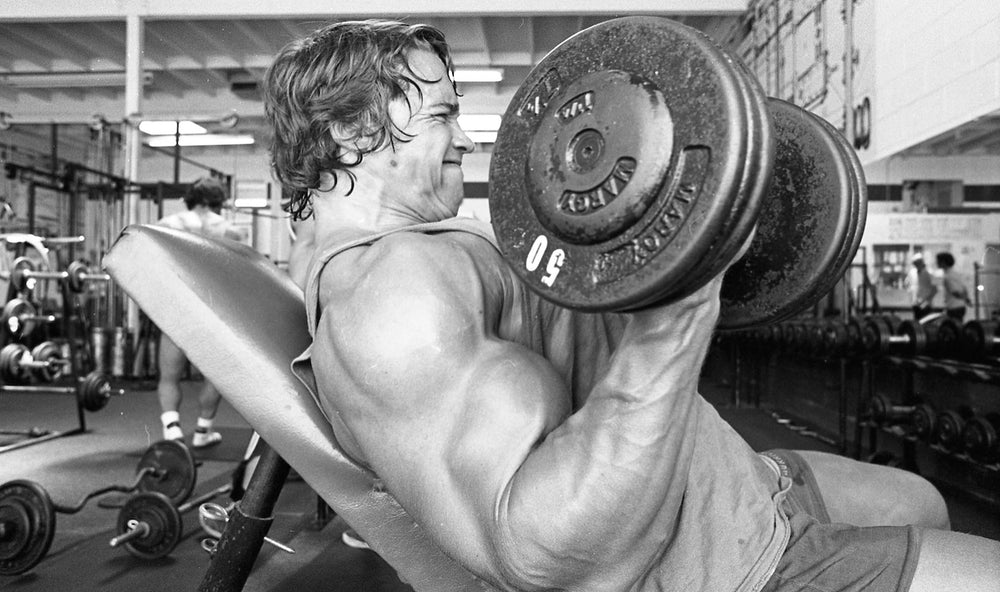
(Around the 1-minute mark, Arnold stopped coaching and couldn’t help but do it himself.)
Superset 1
3A. Dumbbell Romanian deadlift: 3 x 6-8 (30 seconds rest)
3B. Dumbbell rear-foot elevated split squat: 3 x 6-8 (6 seconds rest)
Superset 2
4A. Dumbbell bench press: 3 x 8-12 (30 seconds rest)
4B. Pullup: 3 x 8-12 (60 seconds rest)
Superset 3
5A. Preacher curl: 3 x 6-10 (30 seconds rest)
5B. Lying triceps extension: 3 x 6-10 (60 seconds rest)
Give it a try, and start your week strong!
Better Today
Take any of these tips from today’s email and put them into action:
1. How To Get More Done (And Stop Causing Stress): Arnold Schwarzenegger’s Two Moves to Stop Procrastination
Procrastination has almost nothing to do with laziness or poor time management. It's emotional avoidance: when a task makes you feel annoyed or overwhelmed, putting it off makes the feeling disappear for a moment, not the work. Arnold's fix is two moves: if something takes under two minutes, do it now instead of writing it down; if it's big, break it into the single step you can take today rather than staring up at the whole goal. Momentum beats motivation: the dread vanishes the second you move, so put on the gym clothes, pay the one bill, make the call, and let the mountain shrink behind you.
2. The Viral 'Pinch of Salt in Every Glass' Advice Gets Hydration Science Twisted (And Misunderstood)
Roughly 90% of the water you drink is absorbed in the small intestine through passive osmosis — no added salt or sugar required — so the viral claim that plain water "sits unused" in your gut until you salt it is misleading. Your gut secretes around 8 liters of sodium-rich digestive fluid every day, so the salt-driven transport system always has plenty to work with, and since urine is built by your kidneys from blood, peeing is proof water reached your bloodstream, not evidence you wasted it. Electrolytes earn their keep only once you've actually sweated for them — past about 60–90 minutes, in the heat, or after losing more than ~2% of body weight, where replacing sodium helps your body hold the fluid; for the glass on your desk right now, your body has it handled.
3. Fat Loss Isn't the Only Way to Fight Diabetes. A New Review Says Building Muscle Is Overlooked And Underrated
A new review maps muscle as an endocrine organ that releases signaling molecules called myokines into the bloodstream, which may help defend against obesity and diabetes, although some of the research comes from animal models. What's concrete in humans: muscle is the body's largest site for pulling sugar out of the blood, so more muscle generally means better glucose handling and insulin sensitivity, and animal studies show adding muscle improved metabolism even when diet stayed the same. The takeaway flips the usual script: fat loss still matters, but building muscle is an underappreciated, possibly independent lever for metabolic protection, especially if you're dealing with insulin resistance.
The Positive Corner of The Internet
About Arnold’s Pump Club Editorial Standards
We do things a bit differently here, starting with transparency.
The Content: All APC emails are researched, written, and fact-checked by the APC editors (see bottom of the email), with written contributions from Arnold (noted with “Arnold’s Corner”). Links take you to original studies (not second-hand sources).
Does AI play a role? Not for the primary content, but it is used in two ways. The main items are original content written by the APC team. The summaries at the end are AI-generated based on the human-written content above. We also use an AI tool to review our interpretations of the research and ensure scientific accuracy. We don’t assume AI is right, but we use technology to hold ourselves accountable.
Yes, we have partners (all clearly noted by “Together With”). Why? Because it allows us to keep the APC emails free. We first test products, and then reach out to potential partners who offer ways to help you improve every day. The bar is set high, and to date, we have turned down millions in ad deals. (Example: we will not partner with any non-certified supplements or those without evidence in human trials). If we won’t buy the product, we won’t recommend it to you. And if there’s no evidence it works, then there’s no place for it here.
—
Publisher: Arnold Schwarzenegger
Editors-in-chief: Adam Bornstein and Daniel Ketchell
1