

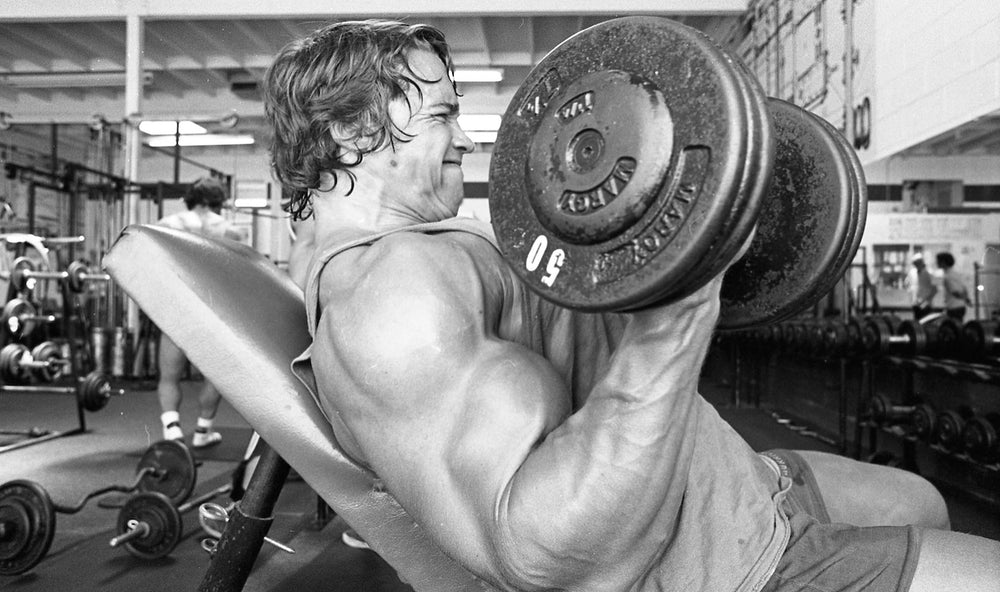

Arnold's Rule for Getting More Done: Stop Taking Yourself So Seriously
Arnold says the secret to doing more — across fitness, politics, and film — is refusing to sweat the small stuff. Here's how to take his mentality and apply it to your life.
Welcome to the positive corner of the internet. We’re here to make your life healthier, happier, and less stressful. At the bottom of each email, we explain our editorial process, stance on AI, and partnership standards.
If you were forwarded this message, you can get the free daily email here.
Today’s Health Upgrade
Arnold’s Corner: Don’t take life too seriously
Are there forever chemicals in your tap water?
Start your week right
The last reps count most
Workout of the week
Arnold’s Corner
Monday Motivation: Don’t Take Life Too Seriously
The last week was incredible.
Hundreds of Pump Club members descended on the house where I grew up in Thal, making lifelong friendships and personal records.
A Vice-President, a Pope, and leaders from around the world speaking in Vienna to share solutions to terminate pollution and inspire each other to never stop.
And then, back to filming this fun, action-packed movie, The Kellys, with an amazing crew.
It was one of those weeks that make my friends say, “Arnold, you’re jumping from fitness to clean energy to Hollywood without stopping — how do you do it?”
The answer is laughter.
I was tremendously proud of all of the work we did this week.
I was proud of the lives we helped change in the Pump Club.
I was proud of the innovations and connections we helped inspire at the Austrian World Summit.
I was proudest of the way we did it.
With joy.
Multiple times this week, people approached us and said, “You guys are different. You’re always laughing.”
World leaders. CEOs. Regular Pump Club members.
When people saw our team, whether it was our policy team in Vienna or our fitness team in Graz and Thal, they immediately saw something different.
We have fun.
Let me tell you something: you would be shocked at how much you can get done every day if you’re having fun.
It makes the work easy.
And I know, a lot of people are thinking, “Good for you, Arnold, but how am I supposed to do that?”
Don’t worry, I’m going to tell you.
We don’t take ourselves that seriously.
We don’t sweat the small stuff.
That’s it. It’s that simple.
My challenge to all of you is to find those moments in your day when you start taking yourself too seriously.
Simple, not easy: 99% of the people we work with take themselves VERY seriously and stress EVERY tiny detail.
“We know that nothing matters.”
I said that to an Ambassador who couldn’t believe how relaxed we were while he was having a meeting with Ketch, Conyers, who runs the Schwarzenegger Institute, Matt Iseman, who MCs our summit, my girlfriend Heather, and me.
His eyes got about as big as you can imagine.
Of course I don’t mean that nothing matters.
I mean that we can tell what actually matters and what doesn’t. Most people in politics can’t. Most people outside of politics can’t, either.
They stress over who sits where, who talks when, what time everything happens — we don’t allow it in.
Are we promoting clean energy? That’s all that matters. All the tiny stuff people do to make themselves busy? We skip.
People do an incredible amount of work just to make themselves look or feel important. We skip that, too.
It’s all ego-driven. People want to look like they’re working hard; they want to feel important, and they let it get in the way of the real mission. They let it waste their time and energy.
Even worse, they let it make them run around as if they haven’t seen a smile in decades.
It’s amazing what you can get done when you let go of the work of controlling every detail to make you look like you matter and just focus on the work that matters.
It loosens everything up. It allows you to laugh at yourself.
This week, my challenge to all of you is to find those moments in your day when you start taking yourself too seriously. When you start spending your time protecting your ego instead of doing the work. When you get lost in a detail that nobody will ever remember.
Find those moments and laugh at yourself.
That’s the start.
Because I guarantee you, no matter who you are, there is something you’re taking much more seriously than it deserves.
We all have our own missions.
But we might as well have some fun.
Life can be hard enough.
Don’t take it too seriously.
The Catch, Answered
Why The Olive Oil-Cancer Connection Was Not Real
Every week, we feature “The Catch,” where we hide a trivia question in one email and then randomly select and reward those who submit the correct answers.
Friday’s Catch: The study that suggested olive oil causes cancer only focused on mice, and tumor growth was linked to the balance of polyunsaturated to monounsaturated fat.
The most important part is that the fat did not cause cancer. They were tracking how different diets affect cancer cell growth in mice bred to develop tumors.
It’s an interesting data point for future research into how diets affect cancer, but not a reason to fear olive oil or to believe it causes health problems.
Together With Rorra
Forever Chemicals Are in Our Tap Water. Here's What It Means For You
Few things rattle you like hearing something might be wrong with your water and not knowing what to do about it. "Forever chemicals" headlines land right on that nerve. Let's sort the real from the hype.
PFAS are probably in your tap water. But it’s not worth panicking over, and there's plenty you can do about it.
The U.S. Geological Survey sampled tap water at 716 sites nationwide and found at least one PFAS in about 45% of it, with very little difference between private wells and public systems. And they tested only 32 of the more than 12,000 PFAS compounds, so 45% is a floor, not a ceiling.
The National Academies found that at dangerous levels, PFAS are linked to certain cancers, thyroid changes, shifts in cholesterol, and small reductions in birth weight. The international cancer agency IARC labels PFOA, one common type, a Group 1 carcinogen.
But let’s be clear about a few important differences: "detected" and "detected at a harmful level" are two different things.
In the study, none of the samples reached dangerous levels, but the issue with PFAS is they accumulate over time in the body.
And the most concerning levels come from people exposed to far more than tap water provides, such as contaminated communities, factory workers, and firefighting foam sites.
But since the goal is to limit PFAS exposure, being aware of your water quality is one of the easiest steps you can take.
And that’s the conversation that matters about forever chemicals: it’s less about whether you're exposed and more about how much exposure you have. And there are plenty of actions you can take to keep your body safe.
You can look up your utility's annual report or your state's PFAS testing data to see what's actually in your supply. Or the easy move is to check the quality of your water.
Much of the U.S. water infrastructure is decades old — some of it well over a century — and bringing it up to current standards is estimated to cost well over $1 trillion.
Your water is one of the few exposures you actually control. You can't do much about the air in a restaurant or the packaging at the store. The faucet in your own kitchen or shower is different, and checking it costs nothing.
That's the step almost everyone skips. You can't filter what you've never measured.
If you want to know about your water quality, Rorra created our favorite free tool. Simply enter your email and ZIP, and they'll show you the top contaminants that have actually been detected in your local water.
No purchase. No filter required to see it. Just your water, on a page. You can get your free water report here.
Start by seeing if you have any reason to worry about what’s in your glass. And then you can worry if you need to help protect your water, or if you should focus on other changes.
Start Your Week Right
How To Absorb More Of The Information You Consume
You've got a book on the nightstand you're forty pages into, and two more behind it you bought before finishing the first. And there’s also an open tab on your phone with a study your friend keeps telling you to read. And that podcast queue that continues to grow.
None of it is junk, and all of it feels like it could help something click. So you keep adding, because more has always felt like progress.
But science tells a different story. At some point, the pile stops helping and starts getting in the way of what you’re trying to accomplish and learn.
A Nobel laureate saw this coming back in 1971. In an essay published by Johns Hopkins Press, the economist Herbert Simon put it in a line that's only aged into the truth:
"A wealth of information creates a poverty of attention."
Information isn't free, he argued. It costs the one thing you can't manufacture more of: your attention. The more sources fighting for it, the less any single one gets.
Fifty years later, the numbers agree with him, and they show up everywhere, including work, where the flood is at least someone's job to organize.
In Microsoft's 2023 survey of 31,000 workers across 31 countries, 68% said they don't get enough uninterrupted focus in a day. Another 62% said they lose too much of it just hunting for information. Not reading it. Finding it. If that's the workplace, picture your nightstand, inbox, social media feeds, and group chats.
It’s easy to treat consumption like a scoreboard. One more book, one more study, one more newsletter, and we figure the people who improve fastest are the ones taking in the most. They're not.
The best learners are ruthless about what they let in. They focus less on how much they consume and more on how much they extract.
It’s something we keep in mind for every newsletter. Less fluff, tighter filters, and a deeper focus on information that allows you to make practical changes that make a difference.
For your sake, that means the bottleneck sits upstream of the reading itself. Nothing in your day forces you to stop, pick out what matters, and decide what deserves your full attention. So everything gets a sliver, and almost nothing gets enough.
Here's something you can try tonight, no tool required. Most of what you read disappears for a boring reason: you never made yourself recall it. You read it, you nodded, you moved on.
Decades of learning research have found the same thing: rereading and highlighting feel productive but barely improve retention, while what actually works is to close the book and pull the ideas back out of your own head. Researchers call it retrieval practice, or the testing effect.
So after the next chapter or episode, or even this newsletter: give it two minutes. Write down, in your own words and without peeking, the two or three things worth keeping. If you can't recall it, you never really had it. That one habit will do more for you than just continuing to add more information into your brain.
Together With ASAS
The Last Reps Count Most
The first reps of a set don't build much. They get you to the doorstep.
You're creating tension, activating motor units, and climbing toward the hard part. Nothing's really growing yet.
The growth comes in the final reps. Those last few grinding reps before failure, when the easy fibers tap out, and your body finally calls in the big motor units it was saving. That's when the muscle gets the signal to change. Same set. But it's the last reps that build.
That’s why training within 1-2 reps of failure, regardless of the weight you use, is what scientists have found triggers muscle growth. It’s worth remembering the next time you want to rack the weight one rep early.
It's true outside the gym too. The early effort gets you to the doorstep. The last bit of effort, the part that's hardest and easiest to skip, is where the actual change happens.
We've been thinking about that with the kids at After-School All-Stars, the non-profit organization Arnold built. For 1.8 million young people in this country growing up with almost no adults in their corner, the hard part isn't wanting more. It's having someone there for the last rep. Someone who says "keep going" when quitting would be easier.
ASAS is that someone. Last year, After School All Stars supported 140,000 kids across 77 cities. And it works: when kids walk in, only 1 in 4 believe good things are coming for them. A year later, more than half do.
We've been raising money for those kids, and we're near the end of the set. These are the last reps.
When you donate today, you not only support the kids but also have a chance to win.
When you give $50 or more, you’ll receive a free month of the Pump Club app (it will land in your inbox the following morning)
The single largest donation will win a Hypervibe whole-body platform, the $2,000 machine built to help you recover and come back stronger.
Best of all, 91 cents of every dollar goes straight to the kids.
The last reps are the ones that count. And today is the final day to make a difference.
Workout Of The Week
The Time-Efficient Metabolic Workout
Over the last two weeks, we’ve shared workouts that build your VO2 max and work capacity. This is more metabolic work, but with a different approach.
Where the “4 x 4” workout we shared two weeks ago builds tolerance to sustained hard efforts, this builds your ability to hit high output and recover fast, over and over. The recovery period is too brief for your heart rate to fully drop, so you bank a lot of cumulative time near your ceiling without ever holding a brutal four-minute effort.
The Workout
Warmup: 5-10 min easy effort, building up to moderate effort. Any type of cardio works.
Set a timer for 12 minutes.
Perform any of the exercises below (see “your exercise options”) at a high intensity (as hard as you can push and maintain) for 30 seconds.
Then, go at an easy pace for 30 seconds. So it’s 30 second high intensity followed by 30 seconds low intensity. Repeat this for 12 rounds.
That can be the entire workout. Or you can rest for 3 to 5 minutes, and repeat for another 12-minute block.
Your Exercise Options
Any of these work, and the 30:30 structure is the same.
Erg (rower/ski/Rogue echo bike): 30s hard pull or sprint / 30s easy spin. This is the ideal option because there’s no skill breakdown when you're gassed.
Kettlebell swings: Fast swings for 30 seconds, set the kettlebell down, and breathe for 30 seconds.
Sandbag: 30 seconds of continuous deadlifts where you pick the bag up and load to one shoulder and then drop the bag, alternating sides. Follow with 30 seconds of rest.
Sled or hill: 30 seconds push or sprint. 30 seconds walk back. The walk back is your recovery.
Give it a try, and start your week strong!
Better Today
Take any of these tips from today’s email and put them into action:
1. Why Arnold Doesn't Sweat the Small Stuff
Arnold believes that not taking himself too seriously has allowed him to succeed in many different arenas. If you want to get more done, it helps to skip the ego-driven busywork most people use to look important and focus only on what actually moves the mission forward.
Why it matters: You get more done when you stop stressing every little thing. Most of what feels urgent today won't matter tomorrow.
Try this: Learn to focus on the big picture outcomes, instead of trying to control every last detail. Catch one moment you're being too serious and laugh at yourself.
2. Forever Chemicals Are in Tap Water. Here's What It Means
A USGS study found PFAS in about 45% of U.S. tap water. But there’s a big difference between "detected" and "dangerous," and the one step almost everyone skips to identify how much you need to worry.
Why it matters: This is not a reason to panic. Not all water contains the forever chemicals, and the levels are far below what is considered a threat. However, small amounts can build up in your body over many years. So it’s good to be informed.
Try this: Look up your ZIP code's water report and see what's in your tap.
3. The Best Learners Don't Read More. They Remember More
A Nobel economist saw information overload coming in 1971. The two-minute habit that beats rereading and highlighting, and why more input isn't progress.
Why it matters: Highlighting feels useful but barely sticks. Reading more and learning are great, but it doesn't help if you forget it all.
Try this: After you read something, close it and write down two things you remember. That’s how you can retain and process more information.
The Positive Corner of The Internet
About Arnold’s Pump Club Editorial Standards
We do things a bit differently here, starting with transparency.
The Content: All APC emails are researched, written, and fact-checked by the APC editors (see bottom of the email), with written contributions from Arnold (noted with “Arnold’s Corner”). Links take you to original studies (not second-hand sources).
Does AI play a role? Not for the primary content, but it is used in two ways. The main items are original content written by the APC team. The summaries at the end are AI-generated based on the human-written content above. We also use an AI tool to review our interpretations of the research and ensure scientific accuracy. We don’t assume AI is right, but we use technology to hold ourselves accountable.
Yes, we have partners (all clearly noted by “Together With”). Why? Because it allows us to keep the APC emails free. We first test products, and then reach out to potential partners who offer ways to help you improve every day. The bar is set high, and to date, we have turned down millions in ad deals. (Example: we will not partner with any non-certified supplements or those without evidence in human trials). If we won’t buy the product, we won’t recommend it to you. And if there’s no evidence it works, then there’s no place for it here.
—
Publisher: Arnold Schwarzenegger
Editors-in-chief: Adam Bornstein and Daniel Ketchell