

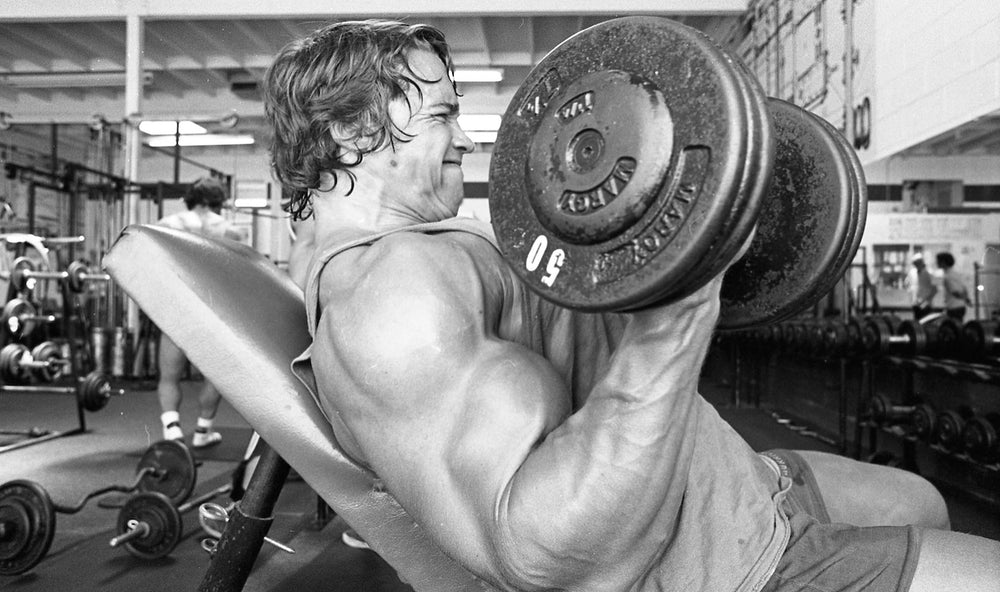

The Three-Word Question Arnold Uses to Stop Overthinking
The next time you battle decision paralysis, Arnold suggests that asking one question will help you cut through the noise and gain the clarity you need to make the right choice.
Welcome to the positive corner of the internet. We’re here to make your life healthier, happier, and less stressful. At the bottom of each email, we explain our editorial process, stance on AI, and partnership standards.
If you were forwarded this message, you can get the free daily email here.
Today’s Health Upgrade
Arnold’s Corner: Monday motivation
Your chance to train with Arnold
Struggle with habits? Try this. (3 fixes)
Workout of the week
Arnold’s Corner
Monday Motivation: What’s the Alternative?
Most of the questions I get about fitness are not really questions.
They are people standing at a fork in the road, staring at it, asking me which way to go. And almost every time, I give them the same three words back.
What’s the alternative?
That is the whole trick. When you are stuck, when your brain is spinning and making a simple thing feel impossible, you stop, and you ask where the other road goes. You look at the choice you are NOT making. And usually, that is the moment everything gets clear.
Let me show you how it works.
People write to me all the time and ask how to become a morning person. “Arnold, how do I wake up early to train?”
They want the secret. The perfect alarm. The cold plunge. The coffee routine. They are convinced the hard part is the waking up.
So I ask them. What’s the alternative?
If you do not wake up early, you do not train.
That is it. That is the other road. So the choice you think you are making, “Do I get out of a warm bed when it is dark and cold,” was never the real choice. The real choice is, “Do I train today or not?”
And that is a completely different question.
Nobody who wants to be strong, who wants to feel good in their body, who wants to be around and healthy for the people they love, looks at “do I train or not” and says no. When you see it that way, the answer is obvious.
The bed was never the problem. Your brain just put a hard costume on an easy decision, so you had a reason to stall.
This is what overthinking actually is. It is not thinking. It is noise. Your brain loves to build a fog around a choice so you can stand in the fog and feel busy and important while you decide nothing. You are not solving anything in the fog. You are hiding.
The fastest way out is to ask where the other road goes.
“Should I cook tonight or just order the easy thing again?”
What’s the alternative? The real choice is whether you want to keep feeling heavy and sluggish or not.
“Should I do my workout? I am so tired today.”
What’s the alternative? The real choice is whether you want to be someone who keeps the promises you make to yourself, or someone who folds the second it gets hard.
“Should I finally start the program?”
What’s the alternative? Another year exactly where you are right now.
See how fast it cuts? The minute you name the real alternative, the noise stops. There is nothing left to debate.
I will tell you something I have said here before. Some days, even for me, the world feels like a black-and-white movie. I wake up, and everything is gray. And then I get on the bike, and I go to the gym, and somewhere in there it turns to color.
The days that start in black and white are the ones that make my routine MORE important, not less.
I know what most people do. When they are tired, when they are down, when they are on a weird schedule or far from home, that is exactly when they skip. They tell themselves they will get back to it tomorrow. They think the choice is “Do I rest today or push.”
But what’s the alternative? The alternative is staying in black and white. The alternative is letting the gray win and waking up tomorrow even further from color.
Once you see that, you go. Tired or not. You do everything you can to get the color back, because you understand what you are really choosing.
This is why I love this little question so much. It does not require willpower. It does not require some special discipline gene that only a few people are born with. It just requires you to be honest about the two roads in front of you.
Most of the time, when you look straight at the alternative, it is ugly. It is a version of you that is weaker, sadder, more stuck, more out of control. And you do not want to walk toward that on purpose. Almost nobody does.
So you stop walking toward it.
Here is your homework for the week. The next time you catch yourself overthinking something, anything, training or work or a hard conversation you keep avoiding, I want you to stop and ask the three words out loud.
What’s the alternative?
Name the road you are actually choosing. Not the dressed-up version your brain handed you. The real one.
Then go do the obvious thing.
It will not feel like a big dramatic decision.
That is the point. The drama was always just noise. Strip it away, look at where both roads really go, and ninety percent of the time the answer was sitting right there the whole time, waiting for you to be honest enough to see it.
Now get after it.
Together With Momentous
One of You Is Going to Train With Arnold
A tub of Fiber+
A trip to your local Vitamin Shoppe.
A private workout with the greatest bodybuilder who ever lived.
Three things that have no business being in the same sentence. But for the next six weeks, they're all connected.
From June 29 through August 9, Momentous, The Vitamin Shoppe, and Arnold’s Pump Club are sending one person to Gold's Gym in Venice Beach for a one-on-one training session with Arnold Schwarzenegger.
It’s not a meet-and-greet or a photo line. It’s a real workout with Arnold. Round-trip flight and hotel covered.
It’s just one day. And a memory and opportunity of a lifetime.
Entering is free and takes about ten seconds. Walk into any Vitamin Shoppe, scan the QR code, and you’re done. No purchase necessary.
Because, like the newsletter, we don’t believe that the best things in life require payment.
But if you want to increase the likelihood of winning, it helps to have skin in the game.
And we want to anchor better odds with better health. Grab a tub of Fiber+ (or any Momentous product), and that's another entry. Snap an in-store selfie, send it to momentous@vitaminshoppe.com, that's another.
Both reset every week, all six weeks. Stack them as high as you want.
So why fiber? Because 95% of Americans still don't get enough, and it’s tied to so many health benefits that — outside of exercise and sleep — you could argue it’s the closest thing we have to “the magic pill.”
Most fibers are inherently flawed.
We built Fiber+ as the first triple-action formula with Momentous to close that gap: soluble, insoluble, and resistant starch in each serving, NSF Certified for Sport, no artificial anything.
The fundamental that almost everyone skips, made by the guy who never did.
The competition starts today. Stop by The Vitamin Shoppe, pick up Fiber+, and give yourself the chance at winning the kind of workout you'll be telling people about for the rest of your life.
Start Your Week Right
Three Ways To Make Habits More Likely To Stick
If your morning workout keeps dying around week three, you probably have a trigger problem. Motivation shows up some days and ghosts you on others, and a habit built on it inherits that flakiness.
What makes a habit stick isn't grit. It's attaching one tiny action to something you already do every single day, so the routine does the remembering for you.
Researchers analyzed 10 studies to determine whether willpower or a consistent cue is more effective at building an exercise habit. The cue won.
People who tied their activity to the same daily trigger and repeated it were more likely to reach the point where moving felt automatic, as if it ran on its own rather than needing a pep talk.
A habit is really just a behavior your brain has stopped arguing about. Early on, doing the thing takes a decision every time, and decisions are exactly what a tired brain wants to skip.
But if you repeat the same action right after the same trigger enough times, your brain links the two. Eventually, the trigger does the nagging for you. You pour the coffee, and you're already preparing for your workout before you can talk yourself out of it.
In the most-cited real-world study on this, people hit "automatic" at wildly different speeds. Some got there in under three weeks, some closer to eight months, with most landing around the two-month mark.
But no matter how long it takes, what makes a habit rock solid is consistency, not perfection. Missing a day here and there doesn’t prevent your habits from sticking.
The cue you pick decides whether any of this works. A good trigger passes three tests.
1) The cue happens every single day without you thinking about it. Brushing your teeth, the first coffee, sitting down at your desk, walking in the door after work. If you have to remember to do the cue, it's not a cue; it's a second habit you haven't built yet.
2) The trigger happens at a reliable time and place. "Sometime in the morning" is too loose for your brain to grab onto. "Right after I pour my coffee, standing in the kitchen" gives it a real hook.
3) The new habit fits naturally right where the cue already lives. Squats work after you climb out of bed because you're already up. A glass of water fits the moment the coffee's brewing. Flossing slots in right after you brush. Pick a cue that flows into the thing instead of fighting it.
This works for whatever you're chasing, not just movement. Want to read more? Hang two pages off the moment you get into bed. Trying to take a daily vitamin? Park the bottle next to your toothbrush. The habit changes. The rule doesn't: find something you already do without fail, and attach the new thing to the back of it.
So start stupidly small. Pick a cue you can't skip (the coffee maker, the moment you get dressed) and attach one easy movement to it.
Give it at least two to three months before you judge it, shrug off the mornings you miss, and get right back on track.
Together With Rogue
Workout Of The Week: Push Your Aerobic Threshold
When you think about intervals, most people picture high-intensity sessions. Sprints or heavy weights done for a short period of time, mixed with shorter rest periods.
The hard interval sessions raise your ceiling. But there’s more to fitness than just how hard you can push. There’s also a matter of sustaining your intensity.
This workout builds your threshold. That’s the "comfortably hard" pace you could sustain for longer stretches. Training here builds a sustainable engine. t
How To Do It
Warmup: Complete 10 minutes of cardio at an easy pace.
The workout: Select an exercise below and do three rounds of 10 minutes.
That means you’ll push your body at a moderately intense pace (you can speak, but it feels hard, and you’d rather focus on the movement). On a 10-point perceived exertion scale, this is 7-8, so the exercise itself is difficult.
After a 10-minute block, rest or go at a super-slow pace for 3-5 minutes, then repeat.
You’ll complete a total of three rounds. By the second round, you’ll likely be cursing the fact that you have one more coming.
Pick your tool:
Ruck
Steady incline walk
Continuous sandbag carry (switch shoulders, keep moving)
Give it a try, and start your week strong!
Better Today
Take any of these tips from today’s email and put them into action:
1. Arnold's Three-Word Question for When You Can't Decide
To stop overthinking, ask "what's the alternative?" — naming the outcome of the road you're not taking reframes a hard-feeling choice as the obvious one it actually is.
Why it matters: Most people ask the wrong questions, and it makes it easier to avoid the behaviors you need most. Reframing the decision shows you the road you're really choosing.
Try this: Next time you stall, name where the other road goes. And then make the right choice.
2. 19 Out of 20 Americans Fall Short on Fiber
About 95% of Americans fail to meet the recommended daily fiber intake, with most eating around half the 28-34 grams adults need.
Why it matters: Fiber keeps your gut, heart, and weight in check.
Try this: Add one fiber food — beans, berries, lentils, oats, avocado, or Fiber+ — to a meal today.
3. Why The Right Cue Is The Key To Building Habits That Stick
Habits stick not through willpower but by repeating a small action right after a stable daily cue — and real-world data shows it takes about 66 days on average (ranging from ~18 days to ~8 months), not the mythical 21.
Why it matters: A habit sticks when you tie it to something you already do. The cue remembers for you, so willpower doesn't have to.
Try this: Take something you do every day at the same time (like brewing coffee), and attach a new habit to it.
The Positive Corner of The Internet
About Arnold’s Pump Club Editorial Standards
We do things a bit differently here, starting with transparency.
The Content: All APC emails are researched, written, and fact-checked by the APC editors (see bottom of the email), with written contributions from Arnold (noted with “Arnold’s Corner”). Links take you to original studies (not second-hand sources).
Does AI play a role? Not for the primary content, but it is used in two ways. The main items are original content written by the APC team. The summaries at the end are AI-generated based on the human-written content above. We also use an AI tool to review our interpretations of the research and ensure scientific accuracy. We don’t assume AI is right, but we use technology to hold ourselves accountable.
Yes, we have partners (all clearly noted by “Together With”). Why? Because it allows us to keep the APC emails free. We first test products, and then reach out to potential partners who offer ways to help you improve every day. The bar is set high, and to date, we have turned down millions in ad deals. (Example: we will not partner with any non-certified supplements or those without evidence in human trials). If we won’t buy the product, we won’t recommend it to you. And if there’s no evidence it works, then there’s no place for it here.
—
Publisher: Arnold Schwarzenegger
Editors-in-chief: Adam Bornstein and Daniel Ketchell