



Welcome to the positive corner of the internet. Every weekday, we help you make sense of the complex world of wellness by analyzing the headlines, simplifying the latest research, and providing quick tips designed to help you stay healthier in under 5 minutes. If you were forwarded this message, you can get the free daily email here.
Today’s Health Upgrade
Short vs. long walks (the surprising science)
Does creatine improve fat burning?
The activity that keeps your brain young
Today’s giving giveaway
On Our Radar
Is One Longer Walk Better Than Many Shorter Walks?
Most people think the secret to better health is hitting a certain number of steps. But a massive new study suggests that how you walk might matter even more than how many steps you take, especially if your steps are limited.
Taking walks lasting at least 10 to 15 minutes was linked to a dramatically lower risk of heart disease and early death, even when total daily steps remained the same.
Researchers followed more than 33,000 adults who averaged fewer than 8,000 daily steps. Everyone wore accelerometers for up to a week, and scientists then tracked their health for nearly 8 years. They weren’t looking at step count; they were studying step patterns, comparing people who took lots of tiny bursts of movement with people who occasionally took longer, continuous walks.
At the end of the study, all-cause mortality was higher among those whose steps mainly consisted of less than 5- or 10-minute walks. Cardiovascular disease risk showed a similar trend among those who regularly accumulated steps in increments of less than 15 minutes.
For people who walked fewer steps each day (<5,000 steps), the benefits were strongest for those who were able to walk for at least 15 minutes, suggesting that even if you can’t walk a lot, going on a longer walk is better than many short ones.
That’s not to say you shouldn’t do short walks if that’s all you have time to do. Because plenty of other studies suggest that some walking, even short bursts, is significantly better than no walking.
The researchers believe sustained walking may be necessary to activate additional benefits in cardiometabolic systems (like insulin sensitivity and vascular function) that don’t kick in during brief incidental movement.
If you’re not hitting big step goals, don’t stress. Instead, build in one daily 15-minute walk. It could be after a meal, between meetings, or while on a call. These simple bouts may deliver outsized benefits, and they fit into almost anyone’s day.
Together With Momentous
Could Creatine Play A Role In Fat-Burning?
If you think creatine is just for building bigger muscles, scientists have a new theory that could change how we view one of the most studied supplements on the planet.
New research suggests that creatine might help your fat cells burn more calories, though the evidence in humans is still early.
A recent review proposes what scientists are calling the “skeletal muscle–adipose creatine axis.” The idea: when you exercise, your muscles don’t just use creatine for strength, they also send chemical messengers to your fat tissue, activating a unique process that burns energy as heat, essentially helping fat cells act more like tiny furnaces.
Human data remain limited, but early studies suggest that people with higher creatine transporter levels in fat tissue tend to be leaner and have better metabolic health.
If you already take creatine and lift weights, keep doing it: those habits are backed by decades of research showing better muscle growth, strength, and overall metabolic health. But don’t expect creatine alone to transform your body composition overnight.
Think of it this way: creatine isn’t just about muscle anymore; it might be part of a bigger system helping your body stay strong, energized, and metabolically resilient.
If you want the cleanest, most reliable creatine to support all of this, Momentous is the gold standard. Their creatine is third-party tested, NSF Certified for Sport, and made with pure Creapure® — the form used in most clinical trials. No fillers. No hidden ingredients. Just the exact dose your muscles and brain (and maybe your metabolism) depend on.
Momentous offers creatine in powder form, on-the-go flavored sticks, and our new favorite, Creatine Chews.
If you take creatine daily, make sure it’s one you can trust every day. Momentous delivers that certainty, and Pump Club members get an exclusive discount of 35% off any subscription (or 14% off a one-time purchase). Just use the code “pumpclub” at checkout.
Instant Health Boost
Can Yoga Keep Your Brain Young?
If you’ve ever walked out of a yoga class feeling clearer, calmer, and a little more you, you’re not imagining it.
Growing research suggests yoga might do something most of us desperately want as we age: keep our minds sharp.
Researchers first noticed something interesting in studies comparing yoga to simple stretching. In one trial, people who practiced yoga had better accuracy on thinking tasks and a calmer cortisol response, while the stretching group showed the opposite. That’s important because higher long-term cortisol is tied to memory loss and even shrinkage of the hippocampus, the part of the brain that stores and organizes your memories.
But the brain benefits go deeper than stress relief. A review of neuroimaging studies found that regular yoga practitioners had more gray matter in regions linked to memory, attention, and decision-making. Even better: the more years someone practiced, the larger these regions tended to be. Think of yoga as a gentle sculptor, adding thickness and volume to the parts of your brain that help you stay sharp.
Yoga also boosts BDNF — a hormone that acts like Miracle-Gro for your neurons — and strengthens connectivity in the brain’s default mode network, which supports memory consolidation. These are the same networks that naturally decline with age.
It appears that yoga works because it supports your brain through three powerful channels: lowering stress, strengthening brain structure, and training the kind of focused attention most of us struggle to practice in daily life.
And that’s what makes yoga unique: it’s not just exercise. The blend of controlled movement, rhythmic breathing, and purposeful attention trains your mind as you move your body. That attentional “reps” component seems to give yoga an edge over walking or stretching alone.
If you want better focus, steadier memory, and a brain that ages more gracefully, 2-3 yoga sessions per week for 45-60 minutes is the sweet spot. Beginners benefit just as much as seasoned practitioners.
Start simple, breathe deeply, and let your mind practice staying where your body already is. Your future brain will thank you.
Lift Up The World
The Hours That Change A Life
The most dangerous hours of the day for a child are 2 to 6 PM. Those four hours shape everything: confidence, safety, school performance, and even long-term earning potential. Kids who have a place to go after school are more likely to graduate, go to college, and build better lives.
That’s why After-School All-Stars exists. They serve 150,000 students in the communities that need it most, providing free programs that boost confidence, keep kids safe, and give parents the peace of mind to work.
Every day this week, the Pump Club is pumping up After-School All-Stars by giving all of you the chance to win special gifts for donating.
If you’ve been looking for a way to spread more light in the world, this is your moment. Make a small donation or any donation, and you’ll help change lives, and you can win in the process.
See below for today’s giveaway.
Today’s Giveaway
Yesterday, we gave away 10 Pump Club GORUCK GR-1 carriers. And today, the giving continues.
Today’s giveaway: A signed copy of Be Useful, a limited-edition Patagonia jacket, and an Austrian bear (with an engraved Arnold signature) — inspired by the one and only Austrian Oak.
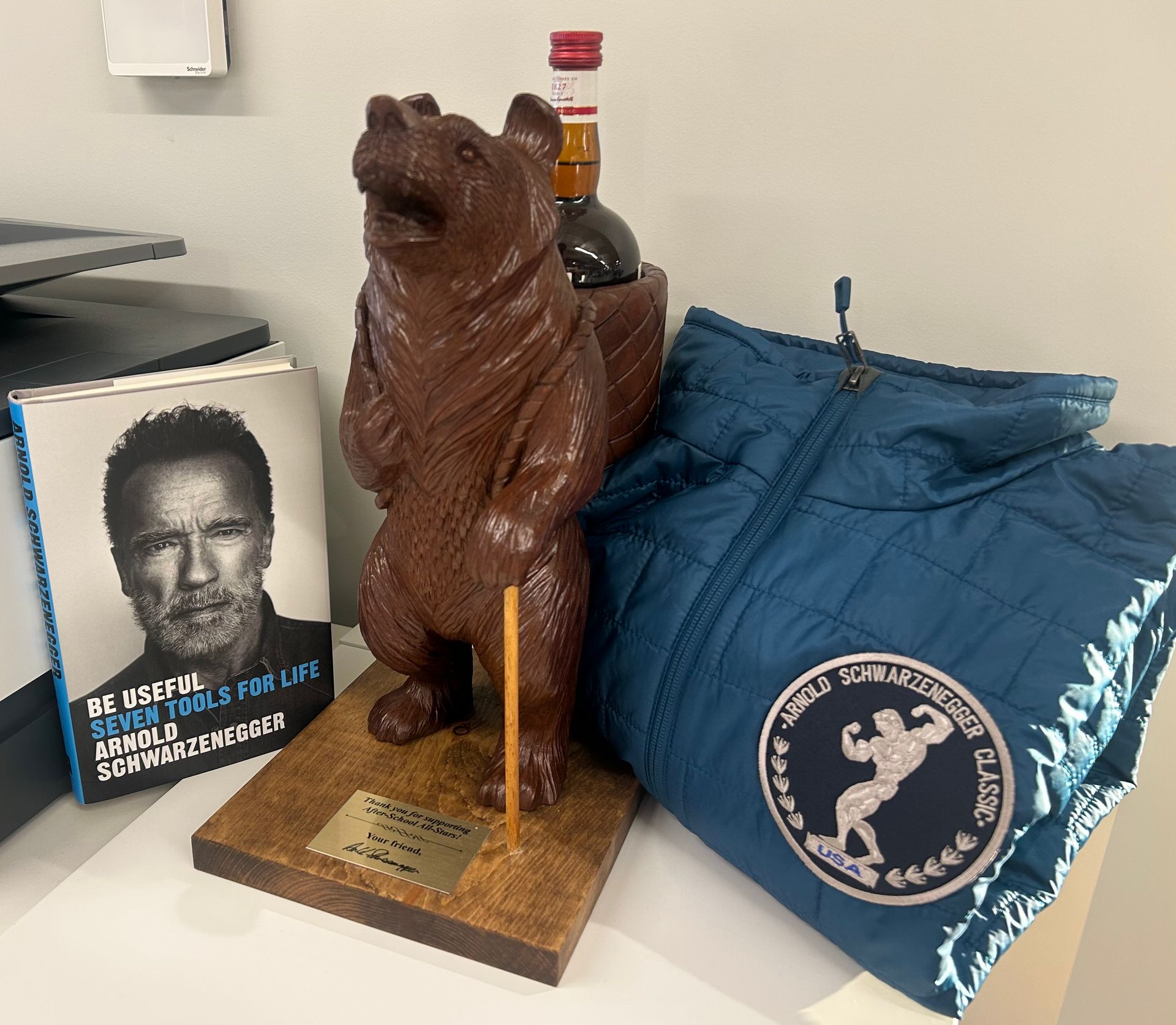
Whoever donates the most in the next 24 hours will receive the prize of the day.
Better Today
Take any of these tips from today’s email and put them into action:
1. How Long You Walk Might Matter More Than Step Count
A study tracking 33,000 adults for nearly 8 years found that walks lasting at least 10-15 minutes significantly reduced heart disease and mortality risk, even when total daily steps stayed the same. For people averaging fewer than 5,000 steps daily, a single 15-minute walk provided stronger cardiovascular protection than multiple shorter bursts, likely because sustained movement activates insulin sensitivity and vascular function that brief walks don't trigger.
2. Why Creatine Might Activate Fat-Burning Pathways
A new scientific review proposes that during exercise, muscles release chemical messengers that signal fat cells to burn energy as heat. Early human data suggest that people with higher creatine transporter levels in fat tissue tend to be leaner and have better metabolic markers. In other words, creatine might help with fat burning on some level. However, direct evidence in humans is still emerging.
3. Performing Yoga Leads To More Gray Matter in Memory and Attention Brain Regions
A neuroimaging review found that regularly practicing yoga can increase gray matter volume in brain regions involved in memory, attention, and decision-making. Yoga also boosts BDNF and lowers cortisol. The research suggests the sweet spot is 2-3 sessions per week, each lasting about 45-60 minutes.
—
Publisher: Arnold Schwarzenegger
Editors-in-chief: Adam Bornstein and Daniel Ketchell