

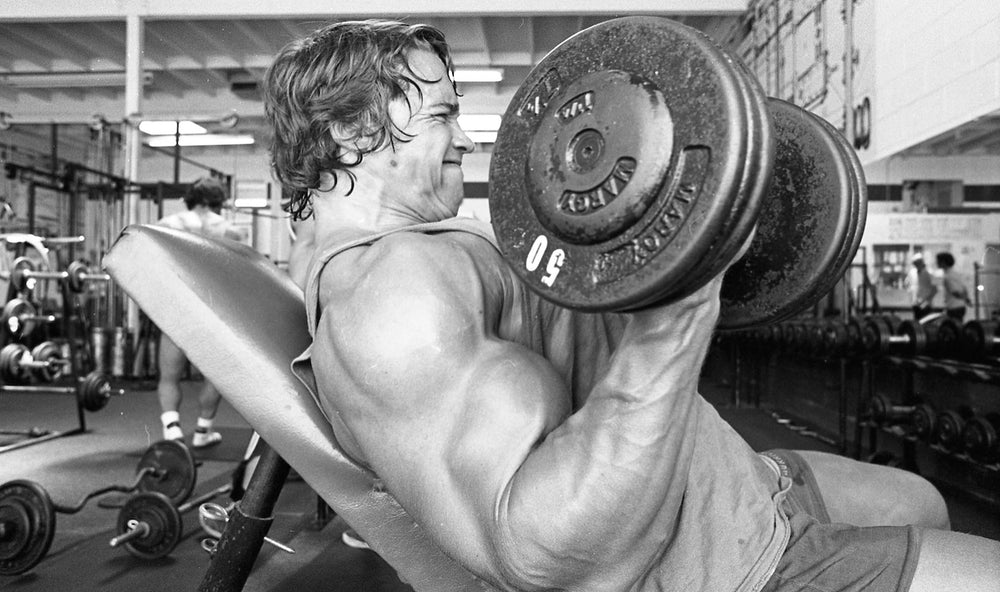

Your Muscle Didn't Turn Into Fat. But Here's Why It Seems Like It.
Measurable decline starts around middle age, at about 1% of muscle mass per year, but much of what we assume is inevitable and file under "aging" is not what it appears to be.
Editor’s Note: Every week, we receive hundreds of emails from all of you. Sometimes, you ask us to go a little deeper to help you understand topics. We save these longer emails on one topic for the weekend.
A friend rolled up his sleeve at dinner last month and flexed, half-joking, the way you do when you already have the punchline lined up.
“Look at this,” he said. “Twenty years ago this was an arm. Now it’s…whatever this is.”
He poked the soft underside of his bicep and gave me a look that was equal parts amusement and resignation. “All the muscle I built in my twenties? It turned to fat. Just part of getting older.”
We hear some version of this constantly. You send it to us in emails weekly. The midsection that went soft. The shoulders that lost their shape. The chest that used to be a chest.
And almost always, the same explanations ride in right behind it: the muscle turned to fat. I got too old. My metabolism slowed down. My hormones are out of balance. My body refuses to change.
Here’s what I tell my friends (if they want my opinion), and what I’ll tell you. You are not imagining the change. Your body did get softer, probably weaker, and the mirror is not lying to you. But the story you’re telling yourself about why is wrong in a very specific way, and that specific way is exactly where all the good news is hiding.
The new science of muscle is changing what we know about aging in real-time, and we’re not even talking about peptides or drugs.
If you can understand how and why your body appears to change, then you’ll see that you have more control than you think over what you can change.
You’re right that something changed about your muscle. You’re just wrong about what. And that gap is the whole game.
The Thing That Didn’t Happen To Your Muscle
Muscle and fat are two different kinds of tissue. One does not become the other, in either direction, ever.
A muscle cell can no more reincarnate as a fat cell than a brick can decide to become a window.
So when people say their muscle “turned to fat,” something real is happening, but it’s two separate processes running at the same time, and you’re blaming one when the culprit is both.
The first process: the muscle gets smaller. With age, and far more with sitting still, muscle tissue shrinks when you stop giving it a reason to stay. A muscle is expensive to keep around, and the body is ruthlessly practical. Use it, and it stays. Ignore it, and it trims the budget.
The second process: fat accumulates. Some settles in the obvious places. But some of it moves into the muscle itself, threading between and inside the fibers, which researchers have linked to weaker, stiffer muscle.
One tissue moves out of the neighborhood; another moves in and takes the same address. That is why the mirror tells such a convincing conversion story. Same spot, opposite tissues.
And here is the relief.
That infiltrating fat tracks closely with inactivity, which means the lever you’ve been hunting for is one you already hold.
The overwhelming evidence suggests that the process of losing muscle and accumulating fat can be slowed and steered in the right direction by the same habits that built the underlying muscle in the first place.
Not erased overnight. Moved. You didn’t melt one thing into another. You lost one tissue and gained the other, and both answer to the same short list of choices.
Aging and Muscle: The One Thing That Happens (Kinda, Sorta, Maybe)
The next thing people say, usually the ones who’ve read a little, is that their fast-twitch muscle turned into slow-twitch. That the explosive fibers became the enduring ones, and that’s why everything feels a step behind.
Mostly, no.
Your muscle runs on roughly two kinds of fibers: in the most basic sense, slow ones built for endurance, fast ones built for speed and power.
As you age, the fast fibers shrink while the slow ones tend to hold their size.
A 2024 review of 27 studies found the overall mix of fiber types barely shifts. You don’t trade your fast fibers in for slow ones. The fast ones simply get smaller.
In another study of older men, the fast fibers measured approximately 29% smaller than in young men. That number is best held as a vivid illustration rather than a universal law: it was men only, a single snapshot in time, and much aging-muscle research still leans male.
There is a small kernel of truth, however.
In advanced age, the nerves that run individual fibers can die off. When that happens, a neighboring nerve sometimes adopts the orphaned fiber and keeps it alive, and because the rescuing nerve is often slower, that fiber can take on a slower character.
That part of muscle fibers changing is real. But it’s reserved for those who make it to their 80s and 90s, not your forties. And it’s a footnote to a much simpler headline with an asterisk: the fast fibers didn’t transform into anything. They shrank. And shrinking is the one thing training is genuinely great at reversing.
*And this effect is not guaranteed and can be limited or prevented by your actions.
What Aging Takes First (And What You Can Take Back)
Father Time is undefeated. But that doesn’t mean you have to give in quietly to aging. Instead, it’s the opposite.
The more you fight to keep what you have, the more you can hold onto your muscle and strength. And even if you start late, your body is still willing to respond and become stronger and more muscular.
Your body starts to lose certain capacities before others, and understanding how gravity works against your body is a blueprint for evolving your training.
Power is the first thing to go.
Power is force times speed. Not just how much you can grind out slowly, but how fast you can produce force at all. It leans on those fast fibers and on how quickly your nervous system can summon them, so it fades faster than either muscle size or slow, grinding strength.
And power is the quality your real life runs on. People spend years chasing size. The quality that decides whether you trust your own body at seventy-five is power, and it deserves its own line in the budget.
What you actually notice in how you move and feel is the loss of power and firmness, and “my muscle turned to fat” is the closest folk explanation on the shelf. It captures the feeling perfectly. It just gets the machinery wrong, and the machinery is the part you can work on.
Second, the power outage starts earlier than almost anyone expects. Measurable decline begins around middle age, at roughly 1% of muscle mass per year, accelerating later in life.
At its most severe, that can add up to losing nearly half your muscle by your eighties or nineties. That’s the worst-case slope, though, not an appointment everyone is required to keep.
Here’s the part that should change how this feels. A large share of what we file under “aging” is really disuse: decades of small surrenders adding up.
The couch instead of the walk. The elevator instead of the stairs. The weights you set down at thirty-eight because life got busy and stressful and never picked back up.
Most of the distance between a sedentary sixty-year-old and a strong one was not handed out at birth. It was built, one unremarkable choice at a time. Which is the whole reason it can be built the other way.
The Iron Age: The Real Longevity Plan
Maintaining your youth does not require you to become a different person. But it does require you to give a damn about your body and fight for your health.
It doesn’t matter if you’re in great shape or have been on the couch for decades. Everything you want can be earned, but it will take effort and consistency.
This isn’t about gender. This is a prescription for everyone.
The science on muscle, strength, power, and function is clear: you don’t just lose it. You lose it because you don’t use it.
Lift things, at least two or three times a week
This is the main lever, full stop. Resistance training rebuilds fiber size at every age anyone has studied, into the eighties and nineties, with the biggest effect landing on exactly the fast fibers that age comes for first.
This is where having a great, customized program matters, not just a random workout of the day, or some high-intensity movements designed to make you sweat. A few full-body movements, something you push, something you pull, something for your legs, and an intelligent progression toward doing a little more over time, without pushing towards burnout or exhaustion. The fibers aren’t gone. They’re waiting for a reason to grow.
Power up: Add a little intensity, a little speed, or (ideally) both
For the power that fades fastest, move some of your reps with intent. In the most basic sense, stand up from a chair quickly. Take the stairs like you mean it. Pick up the pace on a walk.
More intentionally, lift heavy. Maybe not as heavy as you used to, or a need for a 1-rep max, but the need to progressively push yourself. Lifting heavy helps with strength, power, and muscle.
But it’s not just about how much you can load on a bar. It’s about dropping the weight and doing exercises with speed; that’s what helps generate power. It can even be during warm-ups. Move the weight explosively. Jump if your joints can handle it. Sprint.
This mostly buys back power and everyday function, working partly through your nervous system, rather than extra size. But power is what ages out first, so buying it back is time well spent.
Hit your protein
Older muscle needs a louder signal to respond; in practical terms, you have to ask a bit louder to get the same answer. As we age, research suggests we need more protein than when we’re younger, but it’s nothing insane.
At the lower end, expert consensus targets are at least 1.2 grams of protein per kilogram of body weight per day. The more active you are, it might be better to get 1.6 grams of protein per kilogram of your goal body weight. And at the highest end, you’re looking at 1.8-2.2 g/kg. Anything beyond that doesn’t have much to show for it.
Don’t forget to move (outside of your workouts)
Don’t overlook everyday movement. It’s what pushes back on the fat creeping into the muscle and helps keep the wiring between nerve and fiber intact. It doesn’t replace lifting. It makes everything else work better.
Start now
The response to training does shrink a little with age, which is an argument for starting sooner, not that it stops working. The evidence runs all the way into the nineties. The worst time to start was a decade ago. The second-worst time is to keep waiting for a tidier week, putting it off until tomorrow, next week, or next year.
Read this, and then get up for a walk. Bang out some pushups or squats. Run up the stairs. The moment is now. Your body is ready to respond.
Two Roads Diverged in a Yellow Wood, And Sorry I Could Not Travel Both
This is the moment in the road less traveled.
The body that goes soft in middle and older age is not a one-way door clicking shut behind you. The body that changes during menopause is not a moratorium on progress or health. An injury, a lapse in exercise, or even a voice in your head that says, “I’m getting older, maybe I should ease up,” are all illusions that change the message that matters.
Aging is not a flaw. You’re not broken, damaged goods, or past your usefulness.
Your muscle doesn’t betray you and become something else.
Your body changes. It evolves. Some things get harder. But, oftentimes, the changes that occur are a byproduct of you asking less of your body, and your body adjusting to those demands.
It might not be on purpose. Things happen. Injuries suck. Bodily changes are frustrating and emotionally draining.
But there are two paths: one lets you curse the changes, feel sorry for yourself, do less, and watch your body fight you because you stopped sticking up for it.
The other has you push back, remember that you’re still in control, and choose to fight for what you have and what you want your future to look like.
Only one road actually gives you the life you want. And the other gives you sympathy and empathy, but that doesn’t offer you very much when you don’t feel and function the way you want.
That isn’t a verdict. It’s an invitation. You can take the better path whenever you decide to, this weekend even, with a flight of stairs and a real breakfast.
So the next time you flex and joke that it all turned to fat, tell yourself the real story. Those biceps are ready to come back to life when you are. You just have to give them what they need. And, as it turns out, that is something you can start doing again today.
The Quick Recap
Myths travel in packs, so here’s the quick recap to make sure you didn’t miss anything:
Does muscle turn to fat? No. Different tissues, no conversion, not in either direction.
Did your fast-twitch become slow-twitch? Almost entirely no. The fast fibers shrank; the overall mix held.
Is it too late? Not at any age that’s been studied, and that’s all of them.
Doesn’t cardio have it covered? Cardio is wonderful and still part of the healthy aging plan, but it’s not all that matters. And you could argue it’s not the most important type of exercise, either, if your goal is to fight against age-related decline. Rebuilding strength and fast fibers takes lifting weights.
Can you build muscle and strength when you’re older? Yes, clearly and repeatedly. A bit slower than at twenty-five, which is the reason to start now, not the reason to skip it.
—
Publisher: Arnold Schwarzenegger
Editors-in-chief: Adam Bornstein and Daniel Ketchell