


Hope vs. Belief: The Internal Pivot That Precedes Every Lasting Change
One sentence could run your life. Here's how to rewrite it and change your outcomes.
Welcome to the positive corner of the internet. We’re here to make your life healthier, happier, and less stressful. At the bottom of each email, we explain our editorial process, stance on AI, and partnership standards.
If you were forwarded this message, you can get the free daily email here.
Today’s Health Upgrade
Coffee and your kidneys
What new research says about building more muscle
Adam’s Corner: The sentence that runs your life
Beyond The Headline
Coffee and Your Kidneys: What Those Scary Headlines Get Wrong
Somewhere between your second cup and your social media scroll, you might stumble across a story claiming coffee damages your kidneys. The study is real. The panic is a bit overblown.
Despite what some headlines suggest, researchers found that moderate coffee drinkers showed no significant kidney concerns.
That’s the good news. There was one exception to the rule, but it was very specific.
Italian researchers followed adults with stage 1 hypertension for 7.5 years, tracking whether coffee intake affected kidney health differently depending on the primary enzyme that breaks down caffeine (CYP1A2). People with a slower version of this gene keep caffeine in their system longer.
Among slow metabolizers who drank more than three cups per day, researchers observed about 2.7 times higher odds of developing early kidney stress markers compared to those drinking less than one cup daily. This did not mean they got kidney disease.
But more importantly, here’s what most headlines are leaving out: at one to three cups per day, neither genetic group showed meaningful kidney concerns. The elevated risk emerged only when three conditions were met: those who had a heavy coffee intake, elevated blood pressure, and carried the genetic variant.
The study does not suggest coffee is dangerous or that you need a genetic test to enjoy your morning ritual responsibly. But if you have high blood pressure and drink four-plus cups daily, this is a conversation worth having with your doctor.
Fitness
Where You Feel the Stretch Might Be The Key To More Muscle
Most lifters instinctively avoid the hardest part of any exercise. For most moves, it’s the deep stretch at the bottom of a rep, where the muscle is longest, and the tension is greatest. It's the point where many people cut things short, bounce out, or quietly limit their range to what's comfortable.
A new meta-analysis found that resistance training performed at longer muscle lengths — a “lengthen-partial” or the stretched position — produces more muscle growth than the same training done in a shortened position.
A lengthened partial is a partial rep performed in the fully stretched portion of a movement — the bottom half — rather than the top half or full range.
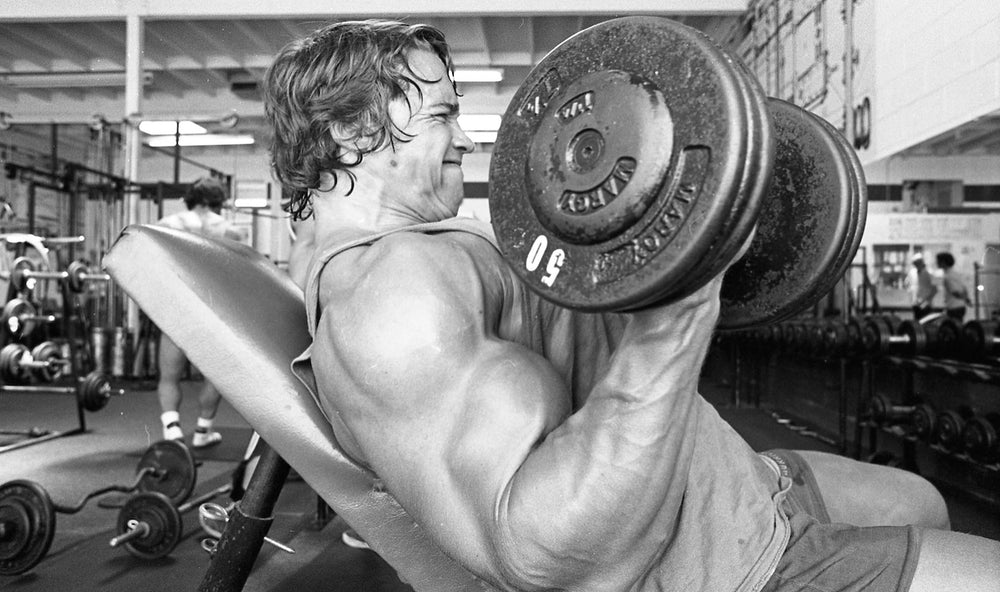
Take a bicep curl as an example. A full rep goes from arms fully extended (bottom) all the way up to fully contracted (top). A lengthened partial stays in the bottom half: you curl from fully extended up to about 90 degrees, then back down. A shortened partial would be the opposite: only working the top half, near peak contraction
Researchers analyzed 8 studies comparing partial-range-of-motion training at long versus short muscle lengths, measuring muscle growth across the quads, calves, and biceps. Training at longer muscle lengths produced measurably greater improvements across multiple regions.
The end regions of the muscle showed an even larger advantage, suggesting the parts of the muscle that are often undertrained respond especially well to stretch-position loading.
The scientists believe that a muscle under tension in its lengthened position generates a stronger growth signal than the same muscle contracting from a shortened position. The exact cellular reasons are still being worked out, but the pattern held consistently across the included studies.
One important note before you start doing only partial reps: this research compared partial reps at long versus short positions, not partials against the full range of motion.
Full range of motion is still the go-to recommendation for your strength training exercises. However, if you have a clear weakness or you avoid the full stretch (which many do in favor of the contraction), it shows where in the rep the most productive work tends to happen. But that doesn’t mean the other part of the rep is worthless.
Adam’s Corner
The Sentence That Runs Your Life
For three days in Los Angeles, we threw a party.
There was music that once you heard a verse, you couldn’t help but start singing along. There were four types of protein- and fiber-rich smoothies to fuel anyone walking by or on their way out of the gym.
And there were challenges. A thousand dollars for the person who could do the most pushups. Another thousand for the longest plank. It wasn’t a gym environment. This was street fitness. All ages and sizes welcome. People would step up, hit the ground, and the crowd watched to see what strangers were made of.
When fatigue kicked in, and the shoulders started to shake, everyone toned down in that particular way a crowd gets quiet when it’s watching someone discover something about themselves they didn’t know was in there. Then the competition would finish, and the cheering brought the space back to life.
There were cameras. There were phones. There were the kind of moments the internet was built to pass around — faces lit up, arms in the air, people hugging strangers they’d met ninety seconds earlier.
Next thing you knew, Arnold would ride up on his bike, and for a second, everyone forgot whatever it had been doing.
It looked like a television commercial for being alive, for being fit, for fueling life the right way.
That was the idea.
But a few blocks away from the buzz, there was a room. No music. No social media. Just four members of our community, each taking a moment to sit down, one at a time, and do the thing we all should do a little more.
They cracked open and let us inside.
These were people whose names Ketchell and I had known for a long time from our interaction in the app. At least, we thought we knew them. And then we discovered there was so much more we were missing.
They sat with their hands in their laps. Nervous laughter. The aura of those who have something important to share but aren’t yet sure how to start.
No one was going to win a thousand dollars in that room.
But what they said was worth more than big giveaways we offered outside.
Stories of Light, Planted In The Dark
Christian went first. A few years ago, he was in a hospital bed. The doctors thought he was having a stroke. He had a four-week-old at home, two other kids, and 250 pounds on a body that had stopped cooperating with him. The thing he couldn’t stop picturing was his wife raising their children alone.
He used to run when the weight would come on quickly. But he couldn’t run anymore. And the weight kept on coming. So he made himself a promise about his visit from the ghost of the future about being alive long enough to matter.
Eighty pounds later, a different man sat across from me.
Then Carlee told us about the postpartum depression that came after her pregnancy. About watching a parent die far too soon. About wanting her two children to grow up with a version of her that was fully there.
There was the moment of “who am I?” when she tried to do step-ups with just her own bodyweight, and she ran out of breath before the set was over. Her young son would mimic her in a way of childish innocence that cut a little too deep. The pregnancy weight was still a burden, but it felt like the least of her concerns.
Her kids see a different mother now. She’s leaner than she’s ever been. Can now deadlift 300 pounds. And is preparing for powerlifting competitions.
Annie is 64. Her biceps are sharp enough that we all took notice. Two years ago, with back problems and a history of heart issues, she realized something about her future. While caring for her mother, she discovered there are two kinds of old people: the ones who have decided there isn’t much left. And the ones who can still do everything and are act like there’s a lot of life ahead.
She intends to be 90 and still thriving. She said it the way a person says a thing they’ve already decided is true.
And then Doms, who grew up watching her mother and sister battle depression, had come to assume it was her future too. The couch. The food. The voice in her head that told her this was just how she was built. Until she decided to talk back to the voice.
It’s hard to believe the person we see today is the same one she talks about. Now, she is lean and confident enough to hop on a flight from Montreal just for a chance to be with her people. That same confidence has her prepping to step on stage.
But when she described what had changed most, it wasn’t her body.
Hope Vs. Belief
Four people. Four ages. Four different lives. Four bodies that used to feel like strangers to the people inside them.
And one powerful thing they had in common. They said things we’ve heard from the thousands of others who have changed in ways that sound like fiction.
Somewhere along the way, each of them stopped hoping their life would get better and started believing it could.
That’s the switch. It’s not a workout. It’s not a meal plan. It’s not an app or a coach or a fresh January calendar. Those are the tools. They help get the job done. But they’re not the pivot.
The pivot is internal. It’s almost impossible to see from the outside. Which is why it almost always happens in a place nobody’s watching. A hospital bed. A couch. A kitchen floor at two in the morning. A car in a parking lot where you sit a minute longer than you meant to, and something shifts.
We sell change like it’s an event. The before-and-after photo. The transformation reel. The story that gets compressed into thirty seconds of captions and a soundtrack. That’s the version the pop-up was designed to create — loud, visible, measurable.
But none of the four people in that office changed their lives by winning anything. In most cases, they felt (in the moment) like they were losing.
They’d changed their lives the moment they decided the life they were living was worth arguing with.
Not in one day. Not in one workout. Not in a single decision that solved everything.
But in one decision that stopped accepting the trajectory they were on.
The One Sentence (We All Have)
Every one of them, before they made that decision, had been carrying around a sentence. Different words. Same function.
This is just who I am.
My family has always been this way.
I’ve tried before. It doesn’t stick.
I’m the kind of person who can’t. Or is too stubborn. Or who doesn’t have the time.
It sounds like self-knowledge. It carries the confessional ring of a grown-up making peace with their limitations. It feels like honesty. Like a hard truth you’ve finally been brave enough to name.
It is not honesty. It is an excuse, a crutch, and a slow-acting poison — all wearing the same face. A rationalization dressed up as wisdom, hiding in plain sight because the alternative is too heavy to carry.
Because if it isn’t your biology, and it isn’t your past, and it isn’t the cards you were dealt, then whatever comes next is your responsibility.
And responsibility is a much harder weight than the one the sentence is protecting you from.
So you keep the sentence. You call it personality. You call it genetics. You call it the way things have always been. You let it explain your life to yourself for years, sometimes decades, and you never quite notice that the cost of keeping it is everything it kept you from becoming.
The answer has been in front of you the whole time.
The four people in that office had each lived on the wrong side of their own sentence for years.
They didn’t change their body first. They changed the sentence.
—
I’ve spent most of my career in fitness, and I can tell you the industry does a lot of things poorly. One of them is selling people the idea that the hard part is the plan. That if you just had the right macros, the right program, the right app, the right coach, the rest would follow.
I’ve written more programs than I can recall. I’ve done nutrition plans. I’ve written books. And together with Arnold and Ketch, I’ve created The Pump Club app. And I’ll be the first to tell you: The plan isn’t the hardest part.
The hardest part is the quiet moment that happens before the plan.
The moment you stop negotiating with a future you don’t actually want. The moment you tell yourself that whatever you’ve accepted about your own life up until now — that you’re the person who can’t stick with it, who always relapses, who was dealt a bad genetic hand, who is too old, too busy, too tired, too late — is a story you’re allowed to edit.
Nobody gets to make that edit for you.
But the opportunity is always there because you hold the pen and get to write the story.
It doesn’t have a timeline. It doesn’t care what day of the week it is, or how many times you’ve walked past it before. It’s just there.
And the strange, deceiving thing about it is how small this life-changing decision feels when you finally make it.
It’s the type of challenge that feels like it deserves a thousand dollars, and instead appears like a footnote.
Because when it happens, you don’t know you’ve made it right away. You won’t have evidence for weeks. Maybe months. Oftentimes years.
But something shifts, and from that moment forward, everything you do is in a slightly different direction.
That’s what Christian made in the hospital bed. That’s what Carlee did the first time she stepped up, couldn’t breathe, and saw her son copy her. That’s what Annie did while watching her mother. That’s what Doms made the first time she talked back to the voice in her head.
None of them knew, at the time, that it was the most important thing they’d ever done.
—
The pop-up was loud on purpose. Attention is one way we invite people in. The music and the prizes and the cameras can get someone to show up for the first time, and there's nothing wrong with that. Because sometimes you need a door wide enough to fit someone who's never walked through one before.
But the thing that actually changes a life is rarely the thing that gets the attention or is captured in the moment.
It's the thing that happens in the quiet room. Or the sadness that consumes you. Maybe it’s a feeling you haven’t noticed. Or, it’s the one you’ve been avoiding, or the one you've been rehearsing without admitting it.
And if there's one thing I'd want you to take from what those four people told me yesterday, it's this: You are probably closer to it than you think.
Not to the transformation. Not to the results. Not to the photo.
To the decision.
To writing that sentence. To deciding the current chapter is over. It had its place. And that the next one will be different.
That moment is nothing more than a decision. And it's one you can still make. -AB
Better Today
Take any of these tips from today’s email and put them into action:
1. Drinking Coffee Is Not A Direct Threat To Your Kidneys (Unless You Meet Very Specific Conditions)
Italian researchers tracked adults with stage 1 hypertension for 7.5 years and found that at a few cups per day, there’s no risk. However, slow caffeine metabolizers drinking more than three cups a day showed elevated early kidney stress markers — about 2.7 times higher odds compared to light drinkers. The risk hinged on a variant of the CYP1A2 gene; fast metabolizers showed no kidney impact at any intake, and neither group showed meaningful concerns at one to three cups per day. If you have high blood pressure and drink 4 or more cups daily, it's worth discussing with your doctor. For everyone else, it appears that one to three cups remains a safe, well-studied territory in nutrition science.
2. The Stretched Position Is Where Muscle Growth Happens
A new meta-analysis of 8 studies found that partial reps performed in the stretched position — the bottom of a movement — produced more muscle growth than partial reps performed in the shortened, contracted position. The effect held across quads, calves, and biceps, and was strongest in the end regions of the muscle (the parts most lifters undertrain), likely because tension on a muscle at full length generates a stronger growth signal than the same load in a shortened range. Full range of motion remains the standard recommendation, but if you've been quietly cutting the stretch short, that's exactly where the most productive work is getting left on the table.
3. Hope vs. Belief: The Internal Pivot That Precedes Every Lasting Change
Real, lasting change isn't sparked by the plan, the program, or a fresh calendar — it's sparked by an internal shift from hoping your life will get better to believing it can. Most people carry a self-limiting sentence — this is just who I am, I've tried before, it doesn't stick — that feels like self-knowledge but functions as a rationalization that protects them from the weight of responsibility for what comes next. The pivot is more subtle than any transformation photo suggests: it's the moment you decide the current chapter is over, and from there every action moves in a slightly different direction.
The Positive Corner of The Internet
About Arnold’s Pump Club Editorial Standards
We do things a bit differently here, starting with transparency.
The Content: All APC emails are researched, written, and fact-checked by the APC editors (see bottom of the email), with written contributions from Arnold (noted with “Arnold’s Corner”). Links take you to original studies (not second-hand sources).
Does AI play a role? Not for the primary content, but it is used in two ways. The main items are original content written by the APC team. The summaries at the end are AI-generated based on the human-written content above. We also use an AI tool to review our interpretations of the research and ensure scientific accuracy. We don’t assume AI is right, but we use technology to hold ourselves accountable.
Yes, we have partners (all clearly noted). Why? Because it allows us to keep the APC emails free. We first test products, and then reach out to potential partners who offer ways to help you improve every day. The bar is set high, and to date, we have turned down millions in ad deals. (Example: we will not partner with any non-certified supplements or those without evidence in human trials). If we won’t buy the product, we won’t recommend it to you. And if there’s no evidence it works, then there’s no place for it here.
—
Publisher: Arnold Schwarzenegger
Editors-in-chief: Adam Bornstein and Daniel Ketchell