


Welcome to the positive corner of the internet. Every weekday, we help you make sense of the complex world of wellness by analyzing the headlines, simplifying the latest research, and providing quick tips designed to help you stay healthier in under 5 minutes. If you were forwarded this message, you can get the free daily email here.
Today’s Health Upgrade
Monday motivation
How to give your brain a boost that lasts
A common pre-workout mistake
Imagine how good you could be (be featured on social)
Workout of the week
The final (and biggest) giveaway
Arnold’s Corner
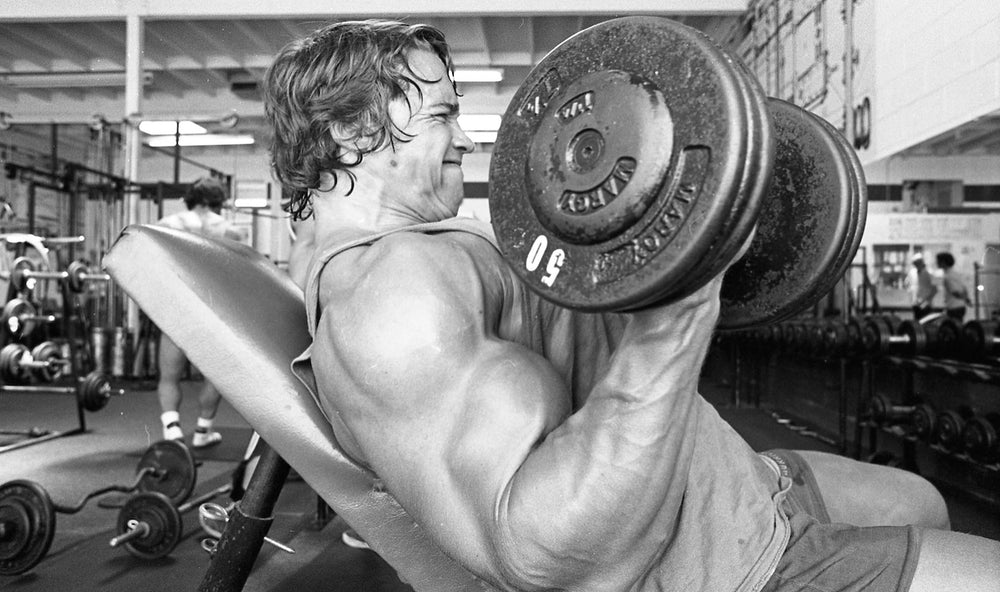
Monday Motivation
People ask me every day how to stay motivated. It just happened again this week on Twitter, and my answer seemed to surprise people, so I want to talk to all of you.
I want to give the cold, hard truth to my readers who are always searching for motivation.
Here is the truth, and I’ve been saying it for decades: Motivation is a terrible plan.
It feels powerful. It feels exciting. But it burns fast, and then it’s gone. And the data proves it.
Studies show that about 50% of people who start a workout routine quit within 3 months.
By 6 months, that number climbs closer to 60 to 70 percent. By one year, only about 20% of people who start exercising are still consistent.
Now look at dieting.
So stats suggest that more than 80% of people who lose weight through dieting regain it. A large percentage regain all of it, and many regain more than they lost within 1 to 3 years. That’s why the average person doesn’t just stay overweight — they slowly gain weight over time.
If motivation worked, this would not be happening.
Now look at “quick transformations.” The fitness industry loves selling 30-day plans, 6-week challenges, and quick fixes.
But research shows that short-term programs have the highest dropout rates and the worst long-term results.
People sprint, burn out, and disappear. This is not because people are weak. It’s because they were taught the wrong strategy.
Motivation is short-term fuel. Routine is the only fuel that lasts.
Now let me show you what happens when people accept that.
Look at these members of the Pump Club app.


Ben has lost 180 pounds so far.
Jeremi has lost 50 pounds and gotten absolutely ripped, and he’s maintained it with greater ease than he ever imagined.
Danielle is in the best shape of her life.
I just trained with all three of them last week because, every so often, I fly out members who have incredible success stories to hear from them firsthand.
So take a guess: Do you think they were motivated every day?
Of course not.
They didn’t succeed because they felt great.
They succeeded because they had a vision — and then they kept showing up.
They aren’t superheroes. They all said they’d tried other things before, and like the vast majority of people, eventually gave up. Sound familiar?
This time, the difference was that they accepted two truths that most people avoid.
First: You show up even when you don’t want to. Especially when you don’t want to. Those days matter more than the easy ones.
Second: This does not end. There is no finish line. There is no “I’m done now.” This is not a 30-day transformation. This is not a summer challenge.
This is a life transformation.
The data backs this up, too.
People who focus on long-term habits instead of short-term goals are dramatically more likely to maintain weight loss and fitness gains.
People who attach their identity to routine — “this is just what I do” — are far more consistent than people chasing motivation.
I want you to ask yourself two questions to really get your head around this:
All the times I started to work out or diet, and I relied on motivation, how did it end?
Every time I told myself there was a finish line — “I’ll lose 20 pounds by March” — what happened after I got to the finish line?
If your answers are what I expect, I want you to remind yourself of the old saying that the definition of insanity is doing the same thing over and over again and again, expecting different results.
And I want you to go into this year with The Pump Club Way:
Routine > Motivation
No finish lines, your routine is for life.
I don’t promise magic.
I don’t promise it will be fast.
I don’t promise it will be easy.
I do promise that if you build a routine, and you show up even when you don’t want to, and you accept that your finish journey has no ending, you will win.
You don’t win by being perfect. You win by being consistent.
Motivation might get you started. But routine is what changes your life.
That’s the Pump Club way. And it’s the only way that actually works.
The Pump Club Way
We don’t just believe you can transform your life and build a consistent routine. We’re willing to bet on it.
When you join the annual plan for the Pump Club app, we’ll pay you back 50% of your cost just for completing The Foundation Program. That’s it.
You have everything to gain and nothing to lose. This time, let’s change your life for good. We’ve got your back.
Bet on yourself, and win big.
Start Your Week Right
Why Worrying Less Could Keep Your Brain Sharp
We all know stress takes a toll on the body. However, new research suggests that the way we think about our problems — replaying worries and dwelling on the negative — may also accelerate cognitive decline as we age.
Adults who spend more time stuck in cycles of repetitive negative thinking scored significantly lower on tests of memory, problem-solving, and spatial skills.
Researchers measured both repetitive negative thinking (the tendency to ruminate on worries) and cognitive performance.
Those in the top half of negative thinking patterns showed measurably worse performance across memory, executive function, and visual-spatial reasoning compared to those with minimal negative thinking.
The researchers controlled for age, education, income, and health, which strengthens confidence in the connection. Still, because the study was cross-sectional, we don’t yet know if negative thinking causes cognitive decline, or if early decline makes people more prone to negative thoughts. But scientists believe repetitive negative thinking is linked to higher cortisol levels and inflammation, both of which damage the brain over time and impair neuroplasticity.
Simply put, constant worry can overwork your stress response system, wearing down your mental sharpness.
The good news? Negative thinking patterns are modifiable. Evidence shows that mindfulness, cognitive behavioral techniques, journaling, and even hobbies can interrupt cycles of rumination.
If you want to change the way your mind works, practice catching yourself in loops of worry and redirecting your focus. Just like lifting weights keeps your muscles strong, flexing your ability to step out of negative thought cycles may help keep your mind sharp for years to come.
Together With LMNT
The Pre-Workout Mistake 50% of People Make
We’ve shared that water is enough for most people to improve hydration. But there’s a catch. If you exercise and sweat, your body needs more than just water.
Research suggests that hydrating with electrolytes before or after your workout could boost performance, reduce fatigue, and improve recovery. And you might be under-fueling more than you think.
Despite the popularity of pre-workout drinks and coffee, one study suggests that at least 50 percent of people begin their workouts dehydrated. And studies suggest that for each percent of water you lose, you’ll see increasing drops in performance.
In other words, while most pre-workout drinks focus on stimulants to give you an extra boost, how hydrated you are before you start exercising matters more than most people realize.
If you show up to your workout already dehydrated, you're starting at a disadvantage that's hard to overcome.
The good news? You don't need a complicated protocol. Just pay attention to your thirst, which should be kept as low as possible during the last hours before exercise by drinking fluids as needed.
A simple check: in the last two hours before exercise, drink enough to produce urine that's pale yellow in color. That’s it. No precise ounce counting required. Just don't ignore thirst before you train, check your urine color, and you're set.
If you train hard and sweat a lot, our go-to drink is LMNT, which provides the electrolytes your body needs without any added sugar, artificial ingredients, or colors.
Your muscles and neurons need electrolytes — such as sodium, potassium, and magnesium. And sweating depletes your body of electrolytes, which can affect performance and recovery.
As an APC reader, you’ll get a free sample pack (8 packets) of every flavor when you make any purchase. Just make sure you use this link, and the free product will be automatically added to your cart to thank you for being part of the positive corner of the internet.
If you don’t love the product, LMNT offers a no-questions-asked refund policy, which means you’ll be satisfied. We recommend using electrolytes before or after your hard workouts lasting longer than an hour to ensure you’re hydrated beforehand and refueled afterward.
The Village
Imagine How Good You Could Be
You know we aren’t into most trends, but this one was too perfect and fit our message, so we think all of you should join in so we can inspire millions more than the million of you receiving this.
We want to highlight you and inspire others.
Step 1:
Follow the instructions below. All you need to do is post something of you enjoying your life.

Step 2
Include the audio here. And then be sure to tag @arnoldspumpclub and @zack_telander.
Fitness
Workout Of The Week
You asked for more quick and effective bodyweight workouts for the holidays, so here are two more options: one bodyweight and one using dumbbells to help keep you consistent even if your schedule and routine are different this week.
The Bodyweight (Zero Equipment) Workout
Perform the workout as a circuit, completing one movement after another and resting 60 seconds between exercises. After you do one set of all four movements, rest for 2 to 3 minutes, and then repeat until all sets are done.
The Workout
Split squat: 4 sets x 8-10 reps/leg
Pushups: 4 sets x as many reps as possible
Single-leg Romanian deadlift: 4 sets x 8-10 reps/leg
Bodyweight IYTs: 4 sets x 8 reps per movement (8 for I’s, Y’s, and Ts’)
Plank: 4 sets x 20-30 seconds
The Dumbbell Workout
Perform the workout as a circuit, completing one movement after another, resting 60 seconds between each exercise. After you do one set of all four movements, rest for 2 to 3 minutes, and then repeat until all sets are done.
Dumbbell Goblet squat: 4 sets x 10-15 reps per leg
Single-arm Dumbbell row (right arm): 4 sets x 10-12 reps
Dumbbell Reverse Lunge (left leg): 4 sets x 10 reps
Single-arm Dumbbell row (left arm): 4 sets x 10-12 reps
Dumbbell Reverse Lunge (right leg): 4 sets x 10 reps
Dumbbell Overhead Press: 4 sets x 8-10 reps
Suitcase carry: 4 sets x 20 seconds
Give it a try, and start your week strong!
Lift Up The World
The Final Day Of Giving
For the last week, 130 APC readers have flexed their giving muscles and shown they have the strength to lift up the world by contributing to After School All Stars.
Today is the final day to give, and the final giveaways have the highest value of anything we’ve offered. The biggest donor in the next 24 hours will receive:
A crystal barbell inscribed with “Thanks for the heavy lifting,” and an engraved Arnold Schwarzenegger signature.
1-year membership to the Pump Club app
Thank you all for showing up for the children who need a steady, safe place to grow. Your donations are now a part of their story.
—
Publisher: Arnold Schwarzenegger
Editors-in-chief: Adam Bornstein and Daniel Ketchell